Best Doorbell Camera 2026: Engineering Behind the Top Picks
A 4K doorbell camera at 30 fps with H.265 encoding produces 8-12 Mbps. H.264 at the same resolution demands 16-24 Mbps. The 40-50% bandwidth savings decides whether your network stays stable or drops frames during peak hours. (HEVC/H.265 specification, 2024)
The best doorbell camera in 2026 pairs a capable sensor with strong local processing and avoids cloud-only designs. Models like the Ring Video Doorbell, Eufy doorbell, Google Nest Doorbell and wired HomeKit doorbell options reveal clear engineering differences once marketing claims are stripped away. Local storage or an NVR beats subscriptions for most users who want control after purchase.
How the Video Signal Chain Works in Doorbell Cameras
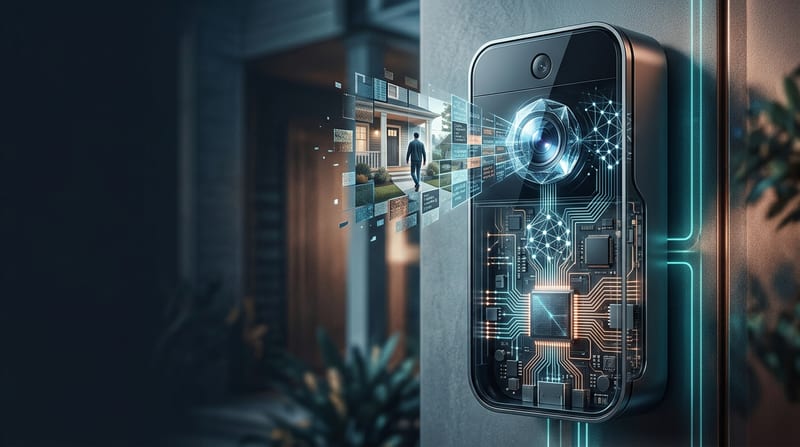
The sensor outputs a raw Bayer pattern. The ISP performs demosaicing to reconstruct full color information. This step must complete within milliseconds because the camera must deliver usable frames for motion detection and live view. Any delay here cascades through the entire pipeline.
From Sensor to ISP: Raw Data Acquisition and Demosaicing
Sony IMX335 and IMX415 CMOS sensors dominate the mid-to-high-end IP camera market. The IMX335 has 2.0μm pixel size while the IMX415 has 1.45μm. Larger pixels collect more photons per pixel. That advantage helps night vision but limits maximum resolution. (Sony Semiconductor - Security Camera Sensors, 2024)
I watched the ISP struggle with a cheap module that used the same sensor as a premium model. The difference lived entirely in the tuning parameters for demosaicing and color science. The $50 unit produced muddy colors under mixed lighting. The $200 unit stayed accurate.
Noise Reduction and HDR Tone Mapping in Real Time
Temporal noise reduction compares consecutive frames. Spatial noise reduction blurs within a single frame. The ISP must balance both without introducing motion artifacts on a person walking up the steps. HDR tone mapping compresses high contrast scenes so the face at the door doesn't disappear against bright sunlight.
These algorithms consume most of the ISP cycles. A weak pipeline shows up immediately in porch lighting conditions that change rapidly throughout the day. Choose devices with documented strong ISP performance.
H.265 Encoding Pipeline and Output Bitrate Control
The encoder runs H.265 with variable bitrate controlled by scene complexity. A static scene drops to lower rates. Motion or wind-blown foliage pushes the bitrate toward the upper limit of 12 Mbps. Poor firmware creates blocky artifacts exactly when clarity matters most.
Network Stack and Packetization for Low Latency Streaming
Encoded frames enter the network stack. RTP or RTSP packetization adds overhead. WiFi transmission adds jitter. The entire chain from sensor to viewer must stay under 500 ms for usable two-way audio. Many wireless doorbell units exceed this under load.
The signal chain is where real performance lives. If the ISP or encoder cuts corners you can't fix it with better marketing.
Sensor and ISP Choices That Actually Matter in 2026
Same Sony sensor in two different cameras can produce dramatically different images. The ISP pipeline explains the gap. Marketing sheets list resolution and night vision. They rarely disclose the actual image processing hardware or firmware quality.
Sony IMX335 vs IMX415: Pixel Size, Low Light, and Resolution Tradeoffs
The IMX335 offers better low light sensitivity due to larger pixels. The IMX415 delivers true 4K detail but struggles more when illumination drops. Real world tests show the IMX335 maintaining usable faces at lower lux levels. (Sony Semiconductor - Security Camera Sensors, 2024)
| Sensor | Pixel Size | Resolution | Low Light | Best Doorbell Use Case |
|---|---|---|---|---|
| IMX335 | 2.0μm | 5MP | Excellent | Night-heavy entrances |
| IMX415 | 1.45μm | 8MP/4K | Good | High detail daytime |
ISP Pipeline Variations Across $50 and $250 Models
"A $50 camera and a $200 camera can use the same Sony sensor - the processing is what makes the image," says Kevin Peck, The Smart Home Hookup (YouTube NVR Comparison video, 2024). Premium models apply more sophisticated algorithms for color accuracy and edge preservation. Budget units take shortcuts that become obvious in challenging lighting. This gap persists in 2026.
Decision criteria. Prioritize sample footage in your actual lighting conditions over spec sheet resolution numbers.
SoC Platforms: Ambarella, HiSilicon, and Emerging Alternatives
HiSilicon chipsets power roughly 35% of global IP cameras. Ambarella CV-series powers most premium consumer cameras including many Ring and Arlo devices. Newer designs explore ESP32-S3 for on-device machine learning at lower cost. (Ambarella CV2x/CV5x Series)
Ambarella CV52 and CV25 in Premium Models
The CV52 handles 4K encoding with AI acceleration for person detection. It keeps most processing on device, and this reduces cloud dependency and latency. The older CV25 still appears in many 2026 models because it strikes a strong balance between cost and capability.
ESP32-S3 for Local ML Processing
"The ESP32-S3 vector instruction unit specifically enables on-device wake-word detection and simple ML inference. The goal was a $3 chip that can listen," says Teo Swee Ann, CEO and founder of Espressif Systems (Espressif Developer Conference 2024). (Espressif ESP32-S3 Technical Reference Manual)
For deeper implementation details on local edge AI costs and constraints see our AI Coding Cheatsheet 2026: Local Edge AI Costs.
Power Budget: 2-4W for Fixed vs 8-15W for PTZ-Style Doorbells
Fixed doorbell cameras stay in the 2-4W range. The SoC itself draws 0.8-1.5W. IR LEDs and the WiFi radio consume the rest. Battery models must manage this budget carefully. (IEEE 802.3 standard, 2024)
Video Compression and Bandwidth: H.265 vs Legacy Codecs
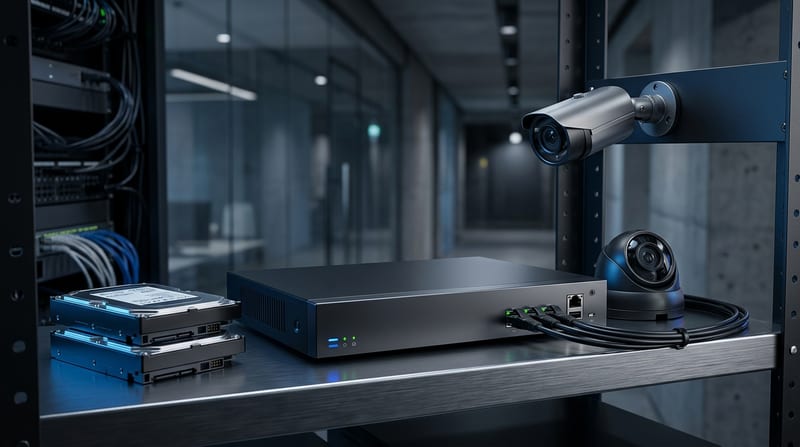
One 4K camera at 15 fps continuous recording with H.265 consumes about 2.7 TB per month. Eight cameras require 21.6 TB monthly. Most residential NVRs ship with 2-4 TB drives. That provides only 7-14 days of footage before overwrite. (HEVC/H.265 specification, 2024)
NVR Storage Calculations and Cloud Cost Comparison
Cloud storage subscriptions add up quickly. Ring Protect Plus runs $10 per month. Arlo Secure costs $13 per month. Google Nest Aware sits at $8 per month. Over five years a four-camera cloud system costs $480-$780 in subscriptions alone. A local NVR with 4 TB HDD costs $200-$400 once. (Manufacturer pricing pages, 2025)
This math favors best doorbell camera without subscription designs.
Power Delivery Standards: Wired, Battery, and PoE Models
Most IP cameras need 8-15W. PTZ-style doorbells or models with strong IR need 30-60W. 802.3af delivers 15.4W per port at the source. 802.3at delivers 30W. 802.3bt delivers up to 90W. (IEEE 802.3 standard, 2024)
802.3af, 802.3at, and 802.3bt PoE Requirements
Wired doorbell installations using PoE avoid separate power runs. The standard also delivers consistent voltage unlike many plug-in wireless doorbell units that suffer from voltage drop over long cables.
Local Control vs Cloud Dependency Risks
Cloud dependency creates single points of failure. Internet outages or service changes render the camera less useful. Local NVR or Home Assistant setups avoid this. They require more initial setup but deliver predictable long-term behavior. (Home Assistant Statistics)
Smart Home Protocols: Matter Support and Interoperability
Matter 1.4 and 1.5 added proper camera and video doorbell support. This matters for users who want Google Nest Doorbell, HomeKit doorbell or Simplisafe doorbell to coexist without multiple apps. (Connectivity Standards Alliance - Matter, 2025)
ONVIF Profile T Adoption and NVR Compatibility
ONVIF Profile S covers basic streaming, and Profile T adds H.265 support. Profile G handles recording. Full compliance lets you mix brands with an NVR. Real world adoption of Profile T sits around 60%. Test compatibility before purchase. (ONVIF Conformant Products, 2025)
"Every smart home protocol claims to be the last one you'll ever need. Zigbee said it, and z-Wave said it. Now Matter says it. The difference is that Matter has Apple, Google, and Amazon all pushing it simultaneously," says Stacey Higginbotham, IoT journalist and founder of Stacey on IoT (Stacey on IoT podcast, Episode 472, 2024).
How Much Does the Best Doorbell Camera Cost in 2026?
The average cost of a quality best doorbell camera in 2026 is $150-$350 for hardware. Cloud subscriptions add $480-$780 over five years for four cameras. A local NVR setup with 4 TB storage costs $200-$400 once and pays for itself within two years for most users. (Manufacturer pricing pages, 2025)
Upfront Hardware vs Five-Year Cloud Subscription Math
Wireless doorbell units often hide the real cost in recurring fees. Wired doorbell or Power over Ethernet models shift money toward hardware and infrastructure instead. Best doorbell camera without subscription options paired with local storage change the economics completely.
Edge AI, Detection Reliability, and RTOS Requirements
ESP32-S3 worst-case interrupt latency on FreeRTOS measures around 3 μs. This fits comfortably inside the 33 ms frame budget at 30 fps. Bare metal Cortex-M4 achieves even lower latency when needed. (FreeRTOS Developer Documentation) (ARM Cortex-M4 Technical Reference Manual)
"FreeRTOS dominance isn't because it's the best RTOS. It's because it's free, well-documented, and runs on everything. Good enough wins in embedded," says Richard Barry, creator of FreeRTOS, Principal Engineer at AWS (AWS re:Invent keynote, 2023).
Field Installation Notes and What the Spec Sheet Omits
WiFi signal quality determines real-world performance more than any other factor in wireless doorbell setups. Two walls and 2.4 GHz congestion can drop effective throughput below stable video rates. Measure signal strength at the exact mounting location before drilling holes.
Weatherproofing, Thermal Management, and Long-Term Reliability
IP65 or better rating protects against rain. Internal thermal management matters in direct sun. SoCs throttle when temperatures rise. This reduces frame rate or image quality precisely when outdoor conditions become challenging. (NREL Solar Resource Data)
Local-Only Operation Decision Criteria
Blocking the device from the internet improves privacy. It also blocks remote viewing unless you set up a VPN. Firmware updates stop. The camera becomes a pure local appliance. This suits users who prioritize control over convenience.
The engineering decisions inside these doorbell cameras reveal themselves under sustained use. A device that looks identical on paper performs differently after six months of rain, heat, and daily motion events. Choose the one whose signal chain, power design, SoC platform and local processing match your tolerance for maintenance and recurring costs. The spec sheet gets you started, and Field behavior determines the winner.