NVR Security Systems Explained: Storage, ONVIF, and Local Setup
An NVR security system records video from IP cameras to a local hard drive instead of a vendor cloud. You control retention, isolation, and access completely, and you avoid the $480-$780 in cloud subscriptions that a typical 4-camera system accumulates over five years. The tradeoff is that you manage storage sizing, drive replacement, and firmware updates yourself. For anyone planning to keep footage longer than a few weeks or who values outage-resilient recording, an NVR is the right architecture.
This guide walks through NVR storage math that actually holds up under real bitrates, the surveillance-HDD firmware details that separate drives that survive from drives that fail in six months, ONVIF compliance that lets you mix camera brands, and the local-only setup pattern that isolates the NVR from the rest of your network.
What an NVR Actually Does
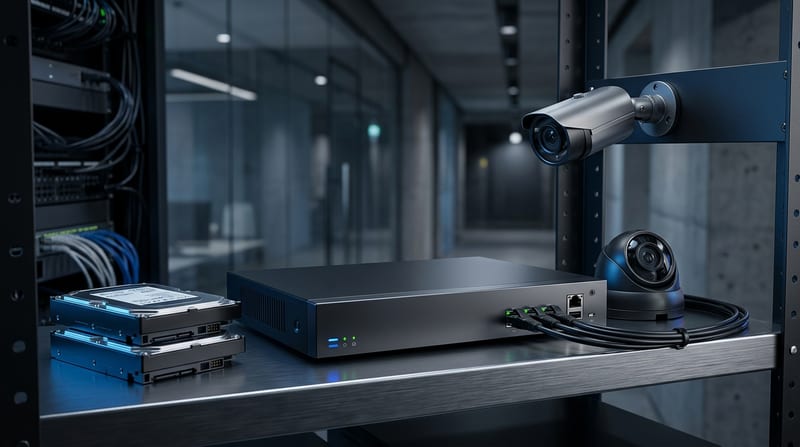
A Network Video Recorder receives RTP-over-UDP streams from IP cameras on a LAN, strips timestamps and metadata, and writes H.265 NAL units sequentially to a surveillance-rated HDD. The cameras do the video encoding; the NVR does network reception, storage scheduling, timeline indexing, and playback. Most residential NVRs also handle motion detection, event tagging, and remote viewing through a web UI or mobile app.
The NVR is not a router. It does not translate addresses or firewall traffic. It sits on the same LAN as the cameras and relies on the network design to isolate the camera subnet from the rest of the house.
For PoE cameras, the NVR either plugs into a separate PoE switch (the cleaner option) or ships with integrated PoE ports on the back panel. Integrated PoE is convenient for small installs. Separate switches are more flexible and easier to replace when the switch or NVR fails independently.
Storage Math That Holds Up Under Real Bitrates
A 4K IP camera at 30 fps using H.265 produces a variable bitrate that averages 8-12 Mbps under typical scene conditions. Continuous recording at 15 fps generates roughly 2.7 TB per month per camera. Eight cameras reach 21.6 TB per month. Most residential NVRs ship with a single 2-4 TB drive, which gives 7-14 days of retention before the oldest footage overwrites.
| Resolution | Codec | FPS | TB per camera per month | 8 cameras, 30 days |
|---|---|---|---|---|
| 4K | H.265 | 15 | 2.7 | 65 TB |
| 4K | H.265 | 10 | 1.8 | 43 TB |
| 1080p | H.265 | 15 | 0.7 | 17 TB |
| 4K | H.264 | 15 | 5.4 | 130 TB |
The H.264 row makes the case for insisting on H.265 cameras in 2026. Same image quality at roughly half the bitrate and half the storage.
Motion-only recording dramatically extends retention at the cost of missing events outside marked detection zones. For most residential use, a hybrid approach works: continuous 15 fps H.265 recording plus motion-triggered 30 fps clips bookmarked on the timeline. That combination retains context around events without eating through storage the way continuous 30 fps would.
A single 24 TB Seagate SkyHawk AI or WD Purple Pro drive now covers 30+ days of 16-camera 4K H.265 motion-only footage without RAID. That capacity shipped in Q1 2026 and removes the "I need RAID just to retain a month of footage" barrier that kept many residential buyers on cloud through 2024.
Why Surveillance-Rated HDDs Are Worth the Premium
Surveillance HDDs ship with firmware tuned for 24/7 sequential writes at 180-550 TB/year sustained throughput. Desktop drives target 55 TB/year. An 8-camera 4K system at 15 fps generates over 260 TB/year of write traffic. A desktop drive in that duty fails in weeks to months. A surveillance drive survives 3-5 years in the same role.
The firmware differences matter more than the MTBF numbers:
- AllFrame AI on WD Purple Pro and ImagePerfect on Seagate SkyHawk AI limit error recovery to under 7 seconds. Desktop drive firmware pauses writes for 8-30 seconds during retries, which shows up in the NVR timeline as missing frames exactly when the camera needed to capture the event.
- Rotational vibration sensors compensate for the vibration other drives in the same enclosure create. In a 4-bay NVR, vibration from three spinning drives can push a consumer drive's head off-track repeatedly.
- Thermal management firmware slows rebuild rates and background scans when the drive temperature rises above 40 °C. Consumer drives run at full speed until they thermally throttle, which causes write stalls.
The $15-25 per-drive premium pays for firmware that treats video as a real-time stream instead of random I/O. Monitor SMART attributes weekly regardless. Reallocated sector count rising above zero is an early warning. Pending sector count above zero is a drive that will fail within weeks.
ONVIF Profiles and Why They Decide Vendor Lock-In
ONVIF defines the protocol that lets cameras from different vendors work with a common NVR. Three profiles matter for most residential and small-commercial deployments:
- Profile S (~90% adoption): basic streaming, PTZ control, video metadata.
- Profile T (~60% adoption): H.265 streaming, advanced motion detection, bi-directional audio.
- Profile G (~40% adoption): server-side recording, storage search, playback protocols.
A camera certified Profile T and G works with any NVR that speaks the same profiles, which means you can mix a Reolink front-door bullet with a Hikvision parking-lot PTZ on an Amcrest NVR and all three record cleanly. Check the ONVIF Conformant Products database before purchase. Vendor claims of "enhanced compatibility" without profile certification numbers usually mean partial or broken compliance.
Partial ONVIF implementations are the trap. Some cameras ship basic Profile S but lack Profile G, which means the NVR can see the stream but cannot record it reliably. Some ship Profile T for streaming but omit the required metadata fields, which breaks timeline search. Test interoperability before committing to a large purchase by putting one camera of each brand on the target NVR for 72 hours.
NVR Channel Count and Drive Bay Planning
Buy an NVR with at least 2x the channel count of your current camera plan. A 4-camera install should sit on an 8-channel NVR. Expansion always happens, and a slightly oversized NVR saves a full replacement 18 months later.
| Channels | Typical bays | Use case |
|---|---|---|
| 4 | 1 | Residential single-drive, 4 cameras max |
| 8 | 1-2 | Residential main system, 4-6 active cameras |
| 16 | 2-4 | Small commercial, 8-14 cameras |
| 32 | 4-8 | Mid-commercial, 14-24 cameras, RAID capable |
| 64+ | 8-16 | Enterprise, RAID 5/6 standard |
RAID 5 or 6 on the NVR's drive pool removes single-drive failure from the risk list on multi-bay units. Hot spares reduce rebuild windows. On single-drive residential NVRs, a weekly backup of the most important clips to a NAS is the closest practical substitute for RAID.
How to Deploy an 8-Camera Local-Only NVR System
- Select ONVIF Profile T and G cameras. Download the conformant products list and cross-reference the exact model before purchase. Test offline operation by blocking the vendor cloud at the firewall before permanent installation.
- Calculate storage for your retention target. 7 days, 14 days, 30 days, and 90 days are all common. Multiply camera count by monthly TB per camera (table above) and divide by 30. Buy the next size up.
- Put the NVR and cameras on an isolated VLAN. Block outbound internet at the firewall except for a narrow NTP allowance and scheduled firmware update windows. The NVR does not need direct cloud access for any legitimate local function.
- Set up WireGuard or OpenVPN for remote viewing. Do not expose the NVR's web UI to the public internet under any circumstances. The CISA Known Exploited Vulnerabilities list includes multiple NVR web-UI vulnerabilities from 2021-2024 that affect retail units that shipped with outdated firmware.
- Configure retention with real scene data. Test by simulating network outages and power cycles. Confirm the NVR timeline shows no gaps longer than one second and every camera continues writing while the WAN is down.
- Schedule weekly SMART monitoring. Alert on reallocated sectors, pending sectors, and temperature excursions. A one-drive rebuild is a nuisance. Data loss is a case lost in court.
Cost Reality for 2026
| Tier | 4-camera system | 8-camera system | 16-camera system |
|---|---|---|---|
| Hardware (cameras + NVR + switch) | $450-$900 | $900-$1,800 | $2,000-$4,500 |
| Drives (1-2 surveillance HDDs) | $120-$250 | $250-$500 | $500-$1,500 |
| Installation (wired labor) | $320-$800 | $640-$1,600 | $1,280-$3,200 |
| Total installed | $890-$1,950 | $1,790-$3,900 | $3,780-$9,200 |
| 5-year cloud equivalent | $2,400-$4,800 | $4,800-$9,600 | N/A at this scale |
A 4-camera local NVR system pays back against cloud subscriptions within 2 years in almost every realistic configuration. The 8-camera system pays back faster because cloud costs scale linearly while local hardware does not.
Commercial installs add 20-40% for NDAA-compliant cameras (Axis, Hanwha, Bosch, Avigilon, Verkada) when grant-funded or government-adjacent buyers require it. Section 179 of the 2025 One Big Beautiful Bill Act lets businesses expense security camera systems up to $2.5M in the year purchased, which accelerates commercial payback meaningfully.
Failure Modes That Take Down Local NVR Systems
Single-drive blast radius. Without RAID or offsite backup, a drive failure loses everything. Either buy a multi-bay NVR and run RAID, or schedule automated clip backups to a NAS or USB drive. The $200 backup destination is insurance worth having.
Firmware updates that reintroduce telemetry. Lock firmware to the last stable version and audit release notes before every upgrade. Some vendors have quietly added cloud check-ins during major version bumps.
Web UI exposure to the public internet. This is the single biggest vector for NVR compromise. Never port-forward the NVR's web UI. Use VPN exclusively for remote access.
Uncontrolled firmware phone-home. Even on an isolated VLAN, cameras and NVRs generate DNS queries, NTP requests, and occasional outbound traffic to vendor domains. Block all of it at the firewall except for explicit exceptions you define yourself.
The Practical Setup
Get the storage calculation right, pick Profile T and G cameras, isolate the NVR to its own VLAN, and use surveillance-rated drives from day one. The rest is monitoring, backup, and firmware discipline applied over the life of the system. A well-designed NVR deployment quietly retains evidence for years without touching the cloud, failing during outages, or exposing footage to a third party. That is what changed in 2026 with the arrival of 24 TB surveillance drives and mature Matter camera support.
Related: Security Camera Local Storage: No Cloud, No Subscription, No Problem | PoE Security Cameras: The Engineering Reality Behind Power Over Ethernet