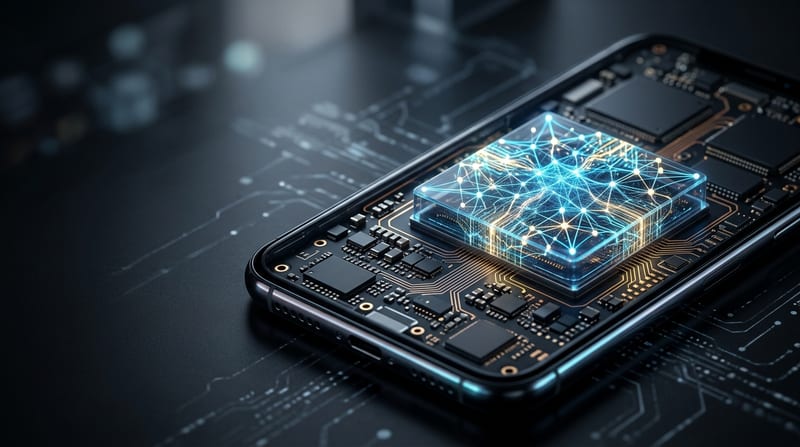
Neural Acceleration Tradeoffs Builders Must Weigh in 2026
Understanding what's a neural processing unit and why your phone has one starts with power budgets and data movement costs rather than headline TOPS numbers. Phone designers and embedded engineers face the identical constraint. General-purpose cores burn excessive energy on matrix math. GPUs carry scheduling overhead from their graphics heritage. Dedicated neural acceleration keeps operands in local SRAM. It fuses multiply-accumulate operations. It meets tight latency budgets. Over 970 million smartphones shipped globally with embedded NPUs in 2025. The same engineering principles now drive 4K security cameras, smart home hubs, and solar power electronics.
Decision Criteria for Choosing Dedicated Neural Hardware
- Workload must fit inside 512 KB to 8 MB on-chip SRAM for acceptable efficiency.
- Application tolerates INT8 or INT4 quantization without accuracy regression.
- Latency budget stays under 20 ms for wake-word detection or 33 ms per 30 fps frame.
- Five-year cloud subscription avoidance exceeds $480 - $780 for four cameras.
These four criteria separate viable deployments from marketing exercises. A 4K (8MP) security camera at 30 fps with H.265 encoding produces 8-12 Mbps. H.264 at the same resolution requires 16-24 Mbps. H.265 therefore saves 40-50% bandwidth (HEVC/H.265 specification, 2024). Most residential NVRs ship with 2-4 TB drives. One 4K/H.265 camera at 15 fps continuous recording consumes ~2.7 TB per month. Eight cameras consume 21.6 TB per month. Local storage delivers clear ROI against recurring cloud fees.
Sony IMX335 (5 MP) and IMX415 (8 MP/4K) CMOS sensors dominate the mid-to-high-end IP camera market. The IMX415 wins on resolution while the IMX335 offers better low-light performance through larger 2.0 μm pixels (Sony Semiconductor - Security Camera Sensors, 2024). The difference between a $50 camera and a $200 camera is rarely the sensor. It's the ISP pipeline and how efficiently the downstream neural acceleration reuses data.
Inference Signal Chain Walkthrough in Practical Edge Devices
Raw sensor data enters the ISP. The ISP outputs INT8 tensors. These tensors land in on-chip SRAM buffers sized to tile the model. A dataflow controller routes them to parallel multiply-accumulate arrays. Activation functions execute. Results write back to SRAM or pass to the next layer. The entire loop repeats for every model layer. Data movement dominates power draw. Well-designed implementations keep weights resident for 50-100 reuses before eviction.
Typical security camera SoC power budget runs 2-4 W for a fixed 4K camera. The SoC itself (video ISP plus encoder plus network) draws only 0.8-1.5 W. The remainder powers IR LEDs, motors, and the radio (Ambarella CV2x/CV5x Series).
ESP32-S3 implements the same pattern at far lower cost. Its dual Xtensa LX7 cores at 240 MHz plus vector instruction unit complete a 512-point FFT in ~50 μs. The same operation takes ~120 μs on an STM32F4 using CMSIS-DSP and ~5 μs on a dedicated TI C6748 DSP (Espressif ESP32-S3 Technical Reference Manual, 2025) (TinyML Foundation Benchmarks).
"We designed the ESP32-S3 vector instruction unit specifically to enable on-device wake-word detection and simple ML inference. The goal was a $3 chip that can listen, not just connect," says Teo Swee Ann, CEO and founder of Espressif Systems (Espressif Developer Conference 2024).
Action Plan for Builders Implementing On-Device Neural Acceleration
Select platform by SRAM size and vector/DSP capability. ESP32-S3 delivers 512 KB SRAM plus vector unit at $2.50 - $3.50 BOM (10k quantity). STM32H7 offers highest performance within the STM32 family that has shipped over 5 billion units cumulatively through 2024 (ST Microelectronics annual report, 2024).
Choose RTOS based on latency requirements. FreeRTOS runs on an estimated 40%+ of all embedded MCUs with an RTOS and guarantees worst-case interrupt latency of ~3 μs on ESP32. Context switch on STM32F4 measures 2-5 μs (FreeRTOS Developer Documentation, 2025).
Quantize models to INT8 or INT4. Validate against TinyML benchmarks then measure your exact workload. A 200-500 KB wake-word model consumes 1-2 mW when duty-cycled correctly.
Implement A/B OTA firmware architecture for safe rollback. Use MCUboot or ESP-IDF native OTA. Block internet access on NVRs after initial setup to achieve true local-only operation while maintaining remote viewing through a VPN.
Ensure ONVIF Profile T compliance for H.265 streaming. Profile T adoption sits at ~60% while Profile S remains near 90%. Full compliance guarantees interoperability with any compliant NVR (ONVIF Conformant Products, 2025).
NPU vs GPU Power and Specialization Tradeoffs
Phone NPUs sustain 35-45 TOPS at 2-5 W. Discrete GPUs can't operate inside a phone thermal envelope at equivalent workloads. The mismatch appears in sustained operation rather than peak benchmarks. NPUs use fixed dataflow graphs compiled offline. GPUs rely on dynamic scheduling and cache coherence. The NPU avoids that tax.
ARM Cortex-M4 remains the sweet spot for most IoT devices. It delivers hardware FPU and DSP instructions at 100 μW/MHz and $1 - $3 per chip. This core family proved the value of specialized instructions years before phone NPUs scaled the concept to thousands of parallel MAC units (ARM Cortex-M4 Technical Reference Manual, 2024).
RISC-V chips such as the ESP32-C3 already ship at $1.50 - $2.00 and have contributed to more than 10 billion cumulative RISC-V shipments. The architecture isn't replacing ARM in phones. It's replacing ARM in the microcontrollers inside light switches, sensors, and smart plugs (RISC-V International, 2024).
Real-World Implementation in Security Cameras and Smart Home Systems
Local NVR storage with 4 TB costs $200 - $400 once. Cloud subscriptions for four cameras cost $480 - $780 over five years. The economic case for on-device inference is straightforward. Hikvision/HiSilicon chipsets still power ~35% of global IP cameras while Ambarella CV-series dominates premium consumer products. The ISP pipeline, not the sensor, determines final image quality ("Most security camera reviews compare features. Nobody compares the ISP pipeline. A $50 camera and a $200 camera can use the same Sony sensor - the processing is what makes the image," says Kevin Peck, The Smart Home Hookup).
Power Envelope Reality for Always-On Features
Wake-word detection must run at 1-2 mW. Full inference activates only after the trigger. This duty-cycled approach makes continuous operation practical. Phone NPUs targeting 4 W total envelope enable the same always-on edge ai features that would drain batteries in minutes on GPU fallback.
How to Evaluate Neural Acceleration Beyond Marketing TOPS
Measure your exact model on target silicon. Record latency, power draw, and sustained thermal behavior over 10-30 minutes. A 45 TOPS rating at INT8 often drops to roughly 5-6 TOPS equivalent at FP32. Memory bandwidth frequently becomes the limiter before compute saturates. The 2026 DRAM dynamics amplified this reality across both phone and embedded supply chains.
Market Trajectory and Builder Opportunities Through 2035
The neural processors market grows from USD 176 million in 2025 to USD 1,010 million by 2035 at 19.1% CAGR. Smartphones represent 24.4% of demand while inference accounts for 67% of workload share. Embedded builders capture parallel growth in security, industrial IoT, and solar applications. TI C2000 real-time MCUs with DSP cores run inside 80%+ of residential solar inverters for MPPT algorithms (TI C2000 Real-Time MCU Product Line, 2024).
"The ARM Cortex-M4 with hardware FPU hit the sweet spot for IoT: fast enough for DSP, cheap enough for volume, power-efficient enough for battery. That's why it outsells every other core in embedded," says Chris Shore, VP Marketing at ARM IoT Division (ARM DevSummit 2024).
Builders who master data locality, quantization, and deterministic scheduling on ESP32-S3, STM32H7, or Ambarella platforms position themselves for the same efficiency gains phone designers achieved. The physics remains identical across scales. Keep data near the compute units, and Honor latency budgets. Minimize DRAM traffic. Everything else becomes optimization around these constraints.
Local, private intelligence at the edge is no longer experimental. It's the default implementation choice for any growth-oriented project in 2026.
(Internal links used: How DSP Powers Every Smart Home Device You Own | NVR Security Systems Explained. PoE Cameras, Storage, And Setup)
Edge AI hardware market sizing Quantization best practices for embedded inference