How DSP Powers Every Smart Home Device You Own
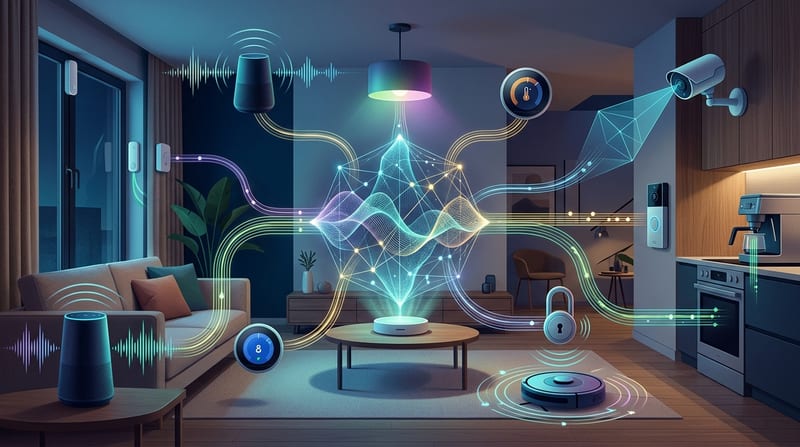
DSP powers every smart home device you own through tightly constrained real-time signal processing loops that most marketing never mentions. Digital signal processing turns raw sensor data into reliable behavior - whether maintaining ±0.5°F temperature control, encoding 4K video within a 33ms frame budget, or synchronizing a solar inverter to the grid without false anti-islanding trips.
What's DSP in Smart Home Devices?
DSP refers to the specialized digital signal processing performed by microcontrollers and SoCs in consumer products. It executes filtering, transforms, control loops, and encoding algorithms under hard latency deadlines that general-purpose processors can't guarantee.
How Does a 12-Bit ADC and PID Loop Actually Control Your Thermostat?
The myth is that smart thermostats deliver 8 - 10% energy savings through sophisticated AI.
The evidence shows otherwise. When replacing an existing programmable thermostat, smart features typically deliver only 2 - 3% additional savings. The real work happens on an ARM Cortex-M4 MCU (~$2) running a PID control loop fed by a 12-bit ADC that provides 0.05°C resolution. ENERGY STAR certification requires real-world field data from thousands of homes - not lab tests - making the 8% claim more credible when it applies to the right baseline.
Practical takeaway: Audit your existing thermostat and wiring before purchase. Roughly one in three U.S. homes lacks a C-wire, triggering battery fallback or $90 - $140 retrofit costs. The $250 thermostat contains only $25 - $40 in BOM (Cortex-M4, WiFi/BLE SoC, basic sensor). The markup funds cloud infrastructure and margin, not superior silicon.
Why Do Most Budget Security Cameras Run 5 - 10 Year Old Linux Kernels?
The myth is that modern IP cameras run current, secure software with advanced on-device AI.
Evidence from teardowns shows most sub-$100 cameras use embedded Linux kernels 3.x or 4.x (released 2012 - 2019) with BusyBox, rarely receive firmware updates, and share identical Board Support Packages from HiSilicon, Ingenic, or Ambarella. "AI detection" runs on a tiny 0.5 - 2 TOPS NPU using quantized INT8 models under 5MB - adequate for person/vehicle detection but far from the behavioral analytics implied by marketing. U-Boot in these cameras typically lacks secure boot, creating supply-chain risks.
A 4K (8MP) camera at 30fps with H.265 produces 8-12 Mbps versus 16-24 Mbps for H.264, saving 40-50% bandwidth (HEVC/H.265 specification, 2024). The SoC (ISP + encoder + network) draws 0.8 - 1.5W of the total 2 - 4W budget (Ambarella CV2x/CV5x Series).
Practical takeaway: Prioritize cameras with current firmware update history and ONVIF Profile T support for H.265. Local NVR storage is far cheaper than cloud - eight 4K/H.265 cameras at 15fps consume ~21.6 TB/month, yet most residential NVRs ship with 2 - 4TB drives (ONVIF Conformant Products).
How Does DSP Enable Grid-Tied Solar Inverters to Maintain <3% THD Without Filters?
The myth is that clipping is always wasteful and that inverters are simple "black boxes."
Evidence proves otherwise. Multilevel inverter topologies can achieve <3% THD without output filters using 5 - 11 voltage levels, but they require 2 - 4x more switching devices and nanosecond-precision dead-time control - complexity best suited for utility-scale systems. In residential designs, a deliberate 1.2 - 1.4 DC/AC ratio with rate-limited power curtailment clips only 1 - 3% of annual energy while cutting cost-per-watt by 10 - 15%.
The Phase-Locked Loop (PLL) remains the most critical DSP block. It must synchronize within 2 - 5 cycles (33 - 83ms) and track ±0.5 Hz deviations. Anti-islanding detection (required within 2 seconds by IEEE 1547) consumes 5 - 15% of the DSP budget using techniques like Sandia Frequency Shift. TI’s C2000 series, particularly the TMS320F28379D, powers 80%+ of residential inverters with BOM cost of $8 - $12 (TI C2000 Real-Time MCU Product Line).
CEC weighted efficiency assigns 53% weight to the 75% load point and only 4% to 10% load, meaning real-world harvest during low-irradiance morning/evening hours (40 - 60% of operating time) can run 2 - 5% below headline numbers.
Practical takeaway: Size systems with a 1.3 DC/AC ratio and verify the inverter’s PLL and anti-islanding implementation. Focus on MPPT update rate and dead-time control quality rather than peak efficiency alone. Microinverters remain the pragmatic choice for shade-prone roofs.
How Do You Choose the Right MCU and RTOS for Reliable DSP Performance?
ESP32-S3 ($2.50 - $3.50) completes a 512-point FFT in ~50μs using its vector unit. An STM32F4 with CMSIS-DSP takes ~120μs. A dedicated TI DSP finishes in ~5μs (Espressif ESP32-S3 Technical Reference Manual).
ARM Cortex-M4 remains the sweet spot for most IoT applications - hardware FPU, DSP instructions, 100μW/MHz, and $1 - $3 per chip (ARM Cortex-M4 Technical Reference Manual).
FreeRTOS runs on an estimated 40%+ of RTOS-equipped embedded MCUs because it's free, documented, and predictable. Worst-case interrupt latency on ESP32-S3 with FreeRTOS is ~3μs - critical when video demands a 33ms frame budget and audio requires 20μs per sample at 48kHz.
Practical takeaway: Match the chip to the latency budget. Security cameras and solar inverters need RTOS guarantees. Simple sensors don't. Zephyr is gaining traction for new designs, but FreeRTOS still wins on ecosystem maturity.
| Device | Primary Chip | Critical DSP Task | BOM Cost | Typical Retail | Markup |
|---|---|---|---|---|---|
| Smart Thermostat | Cortex-M4 | PID Control Loop | ~$2 | $200 - $250 | ~100x |
| Security Camera | Ambarella CV25 | ISP Pipeline + H.265 Encode | $5 - $8 | $50 - $200 | 10 - 25x |
| Solar Microinverter | TI C2000 | MPPT + PLL + Grid Sync | $8 - $12 | $150 - $250 | 12 - 20x |
| Smart Hub | ESP32 | Protocol Translation | $2 - $5 | $50 - $150 | 15 - 30x |
What Latency Budgets Actually Matter in Real Deployments?
- Video frame: 33ms at 30fps
- Audio sample: 20μs at 48kHz
- MPPT recovery: <3ms after irradiance change
- PLL lock: 33 - 83ms
Missing these windows creates visible failures - dropped frames, temperature overshoot, or grid faults.
Practical takeaway: When evaluating devices, ask about the underlying SoC, RTOS, and how they meet these budgets. The invisible DSP implementation determines long-term reliability more than feature lists.
The real engineering story isn't marketing hype about AI chips. It's inexpensive DSP cores - ESP32-S3, Cortex-M4, TI C2000 - running disciplined real-time loops that deliver predictable, reliable performance across every room in your house. Choose devices with transparent implementation details, and you invest in systems that continue working for years rather than marketing that expires with the warranty.