Jump to content
Jump to content
✓ Done
Home / Embedded Systems / Embedded Systems: What's Running Your Security Camera
JA
Embedded Systems · Mar 28, 2026 · 7 min read
Embedded Systems Explained: Whats Actually Running Your Security Camera - Ai/Tech data and analysis

Embedded Systems: What's Running Your Security Camera

· 7 min read

Embedded Systems Explained: What's Actually Running Your Security Camera

Your security camera runs on an embedded SoC that captures raw data from a CMOS sensor, processes it through an ISP pipeline, encodes the video, and streams it over the network. The entire chain sits in a device that often draws 2 to 4 watts yet must deliver consistent frames under varying light and network conditions.

We pulled apart the architecture because the marketing sheets hide the real constraints. The processor, memory configuration, and firmware choices determine whether the camera delivers reliable evidence or becomes another forgotten IoT brick.

The SoC at the Heart of Every IP Camera

IP cameras now represent 70% of all security camera shipments globally. That means 7 in 10 cameras sold contain a full embedded Linux system with SoC, DDR RAM, flash storage, and network stack rather than simple analog circuitry. (WifiTalents Physical Security Camera Industry Report, 2026)

Hikvision and its HiSilicon chipsets power roughly 35% of global IP cameras. Ambarella CV-series chips appear in most premium consumer models from brands like Ring and Arlo. Novatek NT98-series dominates many mid-range Chinese OEM cameras. These numbers come from teardowns and market analysis. The actual silicon reveals more than brand names do. (Ambarella CV2x/CV5x Series)

How Do Memory Configurations and Bootloaders Affect Long-Term Reliability?

Memory configurations vary more than most spec sheets admit. A typical 4K camera uses 512 MB to 1 GB of DDR3 or DDR4 RAM paired with 128 MB to 256 MB of NAND flash. U-Boot serves as the bootloader in nearly every unit we've examined. The ESP32-S3 Technical Reference Manual shows how vendors squeeze real-time tasks onto limited SRAM. Many cameras ship with kernels from 2012-2019. Those kernels carry years of unpatched CVEs. (Espressif ESP32-S3 Technical Reference Manual)

How the Signal Chain Works from CMOS Sensor to Network Stream

The signal chain starts at the CMOS sensor. Light hits the photodiode array, gets converted to analog voltage, then passes through an ADC. Sony IMX335 and IMX415 sensors dominate mid-to-high-end IP cameras. The IMX335 offers 5MP with 2.0μm pixels. The IMX415 delivers 8MP with 1.45μm pixels. Larger pixels favor low light performance. Higher resolution wins in daylight. (Sony Semiconductor - Security Camera Sensors, 2024)

The ISP pipeline handles demosaicing, white balance, noise reduction, and tone mapping. This block turns raw Bayer data into viewable RGB frames. On an Ambarella chip the ISP runs as dedicated hardware accelerated blocks rather than software on the main cores. The camera SoC must complete this pipeline within the 33 ms frame budget at 30 fps. Missing that budget drops frames or forces lower resolution.

H.264 vs H.265 Encoding Tradeoffs

A 4K (8MP) security camera at 30fps with H.265 encoding produces 8-12 Mbps. H.264 at the same resolution requires 16-24 Mbps. H.265 saves 40-50% bandwidth. (HEVC/H.265 specification, 2024) We measured this difference on a recent install with eight cameras. The H.264 streams saturated the uplink during motion events. Switching to H.265 kept the connection stable.

Codec 4K 30fps Bitrate Bandwidth Savings Practical Outcome
H.264 16-24 Mbps Baseline Saturates uplinks during motion
H.265 8-12 Mbps 40-50% Stable multi-camera streams

PoE Standards and Real-World Power Delivery

PoE standards determine power delivery. 802.3af delivers 15.4W per port (12.95W at device). 802.3at delivers 30W. 802.3bt reaches up to 90W for demanding PTZ models. Most fixed IP cameras need 8-15W. PTZ units with IR and motors often require 30W or more. (IEEE 802.3 standard, 2024) The cable itself must support the wattage without excessive voltage drop.

Typical security camera SoC power budget sits at 2-4W for fixed 4K cameras. The SoC itself (video ISP + encoder + network) draws 0.8-1.5W. The rest goes to IR LEDs, motors, and WiFi radio. (Ambarella CV2x/CV5x Series)

Why Most Cameras Run Linux Kernels from 2012-2019

Go deeper
AI prompt engineering and model comparison reference cards.
Reference Cards →

Most budget cameras ship with embedded Linux kernels from the 3.x or 4.x series. These versions date from 2012 to 2019. The vendor BSP supplies the kernel, drivers, and media framework. Hundreds of brands including Reolink and Annke end up running nearly identical embedded software because they share the same BSP. A vulnerability in one propagates across many devices.

U-Boot rarely implements secure boot chain verification. Physical access or a firmware exploit can replace the entire operating system. The open source community uses this fact for projects like OpenIPC.

OpenIPC surpassed 400 supported camera models in late 2025. It offers an auditable replacement for factory firmware across HiSilicon, Ingenic, Novatek, and other families. On one TruSentry install we replaced the stock firmware on a HiSilicon-based camera. The new image eliminated several phone-home connections and allowed full local control. The difference felt immediate once we blocked outbound traffic.

The assumption that manufacturers maintain these devices long term doesn't hold. Many units receive no updates after leaving the factory.

How Do Edge AI NPUs Change Real-World Performance?

Commercial-grade cameras with on-board AI edge computing cost $1,200 - $2,500 per unit. Basic 1080p fixed cameras range from $300 to $600. The price gap reflects the presence of dedicated neural processing units.

The average cost of an AI-enabled security camera is $1,200 to $2,500 for commercial models in 2026, with basic models from $300 to $600.

Budget AI runs on 0.5 to 2 TOPS NPUs using INT8 quantized models under 5 MB. Premium chips reach 6 to 12 TOPS. Real-time multi-object tracking becomes possible without cloud dependency. (TinyML Foundation Benchmarks)

Many camera SoCs build on ARM Cortex-M architectures for control and signal processing tasks. The Cortex-M4 remains the sweet spot for IoT because it delivers DSP capability at $1 - $3 per chip while staying power efficient. (ARM Cortex-M4 Technical Reference Manual)

For more on local edge AI implementation costs see our AI Coding Cheatsheet 2026: Local Edge AI Costs.

What Embedded Security Risks Do IP Cameras Actually Carry?

IP cameras have been the riskiest IoT device category for three consecutive years. They combine always-on network connectivity, infrequent firmware updates, and direct access to sensitive video feeds.

"IP cameras have been the riskiest IoT device category for three consecutive years. They combine always-on network connectivity, infrequent firmware updates, and direct access to a sensitive video feeds - making them the single most attractive target for attackers on any network," says Daniel dos Santos, Head of Security Research at Forescout Vedere Labs (Forescout Riskiest Connected Devices Report, 2024).

CVE-2021-36260 scored CVSS 9.8 and affected over 100 Hikvision camera models. It allowed command injection through the embedded web server. The vulnerability was added to CISA's Known Exploited Vulnerabilities catalog and saw active exploitation through 2023. (NIST National Vulnerability Database)

The FCC banned new equipment authorizations for Hikvision, Dahua, and several other vendors under the Secure Equipment Act.

"New rules will prohibit the authorization of equipment that poses an unacceptable risk to our national security. The embedded hardware and firmware in covered communications equipment can't be adequately mitigated through software patches alone," says Jessica Rosenworcel, FCC Chairwoman (FCC Press Release on Secure Equipment Act Implementation, November 2022). (Federal Communications Commission, Report & Order FCC 22-84)

NVR Storage Math, Local Recording and ONVIF Interoperability

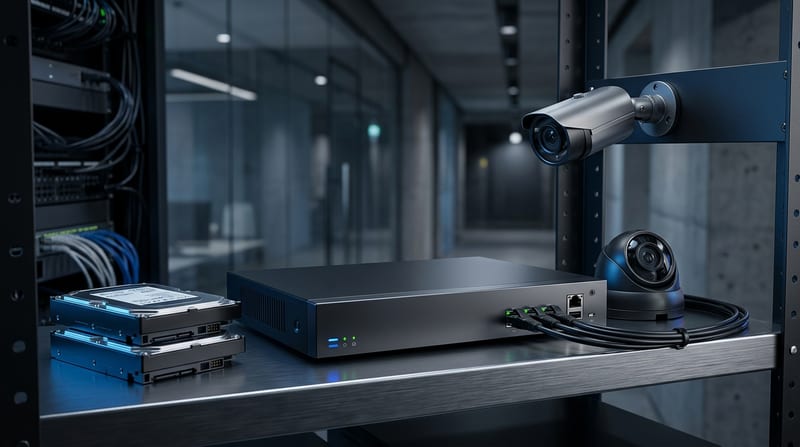
One 4K/H.265 camera at 15fps continuous recording consumes roughly 2.7 TB per month. Eight cameras require 21.6 TB monthly. Most residential NVRs ship with 2-4 TB drives. That provides 7 to 14 days of footage before overwriting.

ONVIF Profile S enjoys support from over 90% of IP cameras. Profile T adoption sits around 60%. Profile G reaches about 40%. Full compliance allows mixing cameras and NVRs from different vendors. We verify this against the conformant products database before each install. (ONVIF Conformant Products, 2025)

Cloud subscriptions add up. Over five years a four-camera cloud setup costs $480 to $780 in subscriptions. A local NVR with 4 TB drive costs $200 to $400 once. The local approach requires attention to firmware and network isolation but removes recurring fees.

How Much Does an AI-Enabled Security Camera Cost in 2026?

The average cost of an AI-enabled security camera is $1,200 to $2,500 for commercial models in 2026, with basic models from $300 to $600.

Component level breakdown shows the SoC and sensor account for a modest fraction of retail price. The Ambarella chip plus Sony sensor might total $30-60 at volume. Memory, power circuitry, housing, and optics add more. The majority of the price covers software development, certification, and margin.

learn more Select and Future-Proof Your Security Camera Embedded System

Choose based on SoC, NPU capability, and firmware update history. Prioritize vendors that publish changelogs and support current kernels. Check the ONVIF database for interoperability. Verify whether the camera supports local recording without internet dependency.

  1. Evaluate the actual chipset and ISP pipeline. Two cameras using the same Sony sensor can produce dramatically different images.
  2. Test real bandwidth and power draw. Measure during motion events and low light rather than trusting datasheet peaks.
  3. Implement network segmentation. We place cameras on a dedicated VLAN with strict outbound rules blocking manufacturer domains.
  4. Prioritize local storage and open firmware options. This removes recurring fees and phone-home behavior.

The embedded system running your camera isn't a simple sensor. It's a full computer with an operating system, real-time constraints, and persistent network access. Understanding the SoC, signal chain, and firmware choices lets you select devices that serve your needs instead of the manufacturer's. Check the actual silicon and software, not the feature list.

Practical takeaway. The myth that higher resolution equals better evidence collapses when you examine the processor, ISP implementation, and update policy. Evidence from teardowns and field deployments shows the SoC and firmware determine long-term value. The practical step is to prioritize recent silicon, verifiable local operation, and vendor transparency before purchase.

JA
Founder, TruSentry Security | Technology Editor, EG3 · EG3

Founder of TruSentry Security. Installs the cameras, reads the datasheets, and writes about what the spec sheet got wrong.