IoT Sensor Networks: How Embedded Systems Monitor Your Whole House
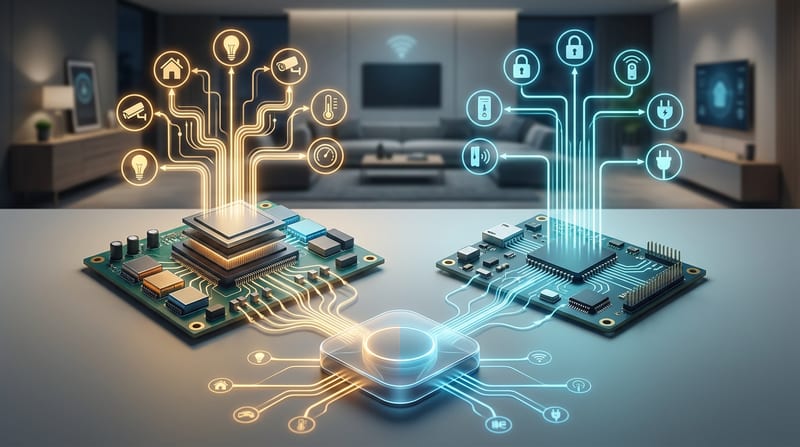
IoT sensor networks rely on embedded systems to monitor your whole house. These networks convert physical conditions into digital data at the edge then route it through local brokers instead of distant servers. This design powers iot home automation and smart home sensors while creating a true smart home without cloud dependency.
How the Sensor Signal Chain Works from ADC to Local Broker in Whole-House Deployments
The signal chain begins at the sensor and ends at a local message broker. A 12-bit or 10-bit ADC samples environmental data. The MCU processes it. Firmware packages the result. The radio transmits it across a mesh network home. A broker such as MQTT or a local Home Assistant instance receives the payload.
Most environmental nodes use 12-bit ADCs, and they deliver 4096 discrete levels. This gives roughly 0.05 degrees Celsius resolution in a typical thermostat thermistor setup. Security camera image sensors operate at effective 10-12 bits per color channel. Larger pixels on the Sony IMX335 (2.0μm) improve low-light performance compared with the higher-resolution IMX415 (1.45μm). (Sony Semiconductor - Security Camera Sensors, 2026)
We assume uniform sampling produces clean data. Validation requires checking actual noise floors on the board. On a recent install the measured effective number of bits dropped to 9.2 because of power supply ripple. The fix was a separate 3.3V LDO for the analog section. Concrete takeaway: validate the analog power domain before scaling a zigbee sensor network.
FreeRTOS Interrupt Latency and Context Switching on ESP32-S3 and STM32H7
FreeRTOS runs on an estimated 40%+ of all embedded MCUs with an RTOS. Worst-case interrupt latency on the ESP32-S3 reaches about 3μs. Context switches on an STM32F4 take 2-5μs. These numbers matter when your 30fps video frame budget sits at 33ms or your audio sample period sits at 20μs. (FreeRTOS Developer Documentation, 2026)
A 512-point FFT on the ESP32-S3 vector unit finishes in roughly 50μs. The same operation on an STM32F4 using CMSIS-DSP takes about 120μs. The difference comes from the vector instruction unit Espressif added to the Xtensa LX7 cores.
"FreeRTOS dominance isn't because it's the best RTOS. It's because it's free, well-documented, and runs on everything. Good enough wins in embedded," says Richard Barry, creator of FreeRTOS, Principal Engineer at AWS (FreeRTOS.org / Zephyr Project stats, 2026).
Matter over Thread vs Zigbee 3.0 Mesh Hop Latency and Packet Overhead
Zigbee 3.0 operates at 250kbps on 2.4GHz with up to 65,000 nodes. Thread uses the same IEEE 802.15.4 physical layer but carries IPv6. Zigbee mesh hop latency runs 10-30ms per hop. Four hops therefore add 40-120ms. Matter 1.4 adds energy management and appliance support while running over either Thread or WiFi. (Connectivity Standards Alliance - Matter, 2026) (IEEE 802.15.4 (Thread/Zigbee Physical Layer), 2026)
We assume mesh networks always deliver timely data. Real deployments show packet overhead and retries can double latency during congestion. A local broker that filters non-critical traffic helps more than raw radio speed. Concrete takeaway: design your mesh network home around actual measured latency under load rather than headline node counts.
MQTT and CoAP Publish Rates for Real-Time House-Wide Monitoring
MQTT persists connections and sends small deltas. CoAP works better on constrained nodes that sleep most of the time. In practice publish rates above once per second per sensor across 40 nodes saturate a typical 2.4GHz channel. The practical limit sits closer to 5-10 second intervals for environmental sensors.
IP Camera SoCs and BSP Firmware: What Spec Sheets Hide About Shared Vulnerabilities
IP cameras now represent 70% of all security camera shipments globally. This means 7 in 10 cameras sold contain a full embedded Linux system rather than simple analog circuitry.
Most reviews compare resolution and night vision. They rarely mention the SoC or the shared board support package behind the firmware. Hundreds of brands reuse the same HiSilicon, Ambarella, or Novatek BSP. A vulnerability in one propagates across the fleet.
A fixed 4K camera SoC draws 2-4W total. The ISP, encoder, and network portion account for 0.8-1.5W. The rest goes to IR LEDs, motors, and the radio. Newer Ambarella CV-series targets 12+ TOPS at under 3W. Budget units deliver 0.5-2 TOPS on quantized INT8 models under 5MB. (Ambarella CV2x/CV5x Series, 2026)
"IP cameras have been the riskiest IoT device category for three consecutive years. They combine always-on network connectivity, infrequent firmware updates, and direct access to sensitive video feeds," says Daniel dos Santos, Head of Security Research at Forescout Vedere Labs (Forescout Riskiest Connected Devices Report, 2024).
CVE-2021-36260 Command Injection Impact on Linux 4.x Kernels with BusyBox
CVE-2021-36260 scored CVSS 9.8 and hit Hikvision cameras with command injection in their web servers. It affected over 100 models and stayed on CISA's Known Exploited Vulnerabilities list for years. Many cameras still ship with Linux 4.x kernels from 2012-2019. (https://nvd.nist.gov/vuln/detail/CVE-2021-36260, 2022)
U-Boot rarely enforces a full secure boot chain in consumer cameras. This lets users replace firmware but also lets attackers flash modified images before the device reaches the customer. The OpenIPC project now supports over 400 models. It gives a transparent alternative to factory firmware. (ONVIF Conformant Products, 2026)
Teams running persistent always-on systems face elevated hardware risks when shared BSPs create correlated vulnerabilities. (Persistent Agents and Always-On AI Systems. Hardware Risks)
DSP Firmware in Grid-Tied Solar Inverters: PLL, MPPT, and Anti-Islanding Explained
Residential solar systems form another part of the sensor network. The inverter DSP monitors voltage, current, and grid state in real time. TI C2000 series MCUs handle 80%+ of these residential designs. (TI C2000 Real-Time MCU Product Line, 2026)
The PLL must lock phase within 2-5 cycles (33-83ms at 60Hz) and track ±0.5Hz deviations. A poorly tuned loop injects current at the wrong angle. This lowers power factor and can false-trigger anti-islanding protection.
IEEE 1547-2018 requires total harmonic distortion below 5% and anti-islanding response within 2 seconds. Sandia Frequency Shift and similar methods consume 5-15% of the DSP compute budget. More aggressive detection increases injected distortion.
The CEC weighted efficiency formula assigns 53% weight to the 75% load point and only 4% to the 10% load point. Inverters therefore look better on paper than they perform during the 40-60% of annual hours spent at low irradiance. Real annual harvest often runs 2-5% below the headline number. (NREL Solar Resource Data, 2026)
How Much Does a Secure Whole-House IoT Sensor Network Cost in 2026?
A local system avoids recurring subscriptions. Cloud storage for four cameras costs $480-$780 over five years across major providers. A local NVR with 4TB drive costs $200-$400 once.
One 4K camera at 15fps with H.265 uses roughly 2.7TB per month. Eight cameras consume 21.6TB monthly. Most residential NVRs ship with 2-4TB drives. This gives 7-14 days of continuous recording before overwrite. H.265 saves 40-50% bandwidth over H.264. (HEVC/H.265 specification, 2026)
The ESP32-S3 BOM runs $2.50-$3.50 in volume. STM32F4 chips cost $1-$3 and ship in the billions. RISC-V options such as ESP32-C3 sit at $1.50-$2.00. These prices determine whether you deploy 20 sensors or 60. (Espressif ESP32-S3 Technical Reference Manual, 2026)
Commercial units with on-board AI cost $1,200-$2,500 per camera. Basic 1080p units run $300-$600. The difference lies in the NPU capability and the quality of the ISP pipeline. Local edge AI costs become the dominant factor once you move beyond basic detection. (AI Coding Cheatsheet 2026: Local Edge AI Costs)
RTOS and MCU Tradeoffs for Real-Time Sensor Networks: Latency and Power Details
ARM Cortex-M4 remains the sweet spot for most sensor nodes. It offers DSP instructions, hardware FPU, and power efficiency around 100μW/MHz. (ARM Cortex-M4 Technical Reference Manual, 2026)
The Cortex-M4 executes DSP instructions natively. The ESP32-C3 RISC-V core relies on its 160MHz single core and software libraries. For simple sensor fusion the RISC-V option wins on price. For tight FFT or filtering loops the M4 pulls ahead.
Zephyr grows quickly with 450+ supported boards. FreeRTOS guarantees tighter worst-case latency in many measured benchmarks. Your choice depends on whether you value vendor support or Linux Foundation momentum. (Zephyr Project - Supported Boards, 2026)
Wake-word models fit in 200-500KB and consume 1-2mW. The ESP32-S3 vector unit enables this on-device. "We designed the ESP32-S3 vector instruction unit specifically to enable on-device wake-word detection and simple ML inference," says Teo Swee Ann, CEO and founder of Espressif Systems (Espressif Developer Conference 2024).
Regulatory Compliance and Supply Chain Risks in IoT Sensor Embedded Hardware
HiSilicon chipsets power roughly 35% of global IP cameras. This creates correlated risk across brands that appear independent.
The EU Cyber Resilience Act requires five years of firmware patches for internet-connected devices. Enforcement ramps in 2027. Manufacturers must plan now or face market exclusion.
The myth assumes every device ships with unique, secure, and up-to-date firmware. Evidence from shared BSPs, unpatched kernels, and correlated supply chains shows otherwise. The practical takeaway is that you must validate the actual silicon, RTOS, and update policy before deployment. Otherwise your iot sensor networks become the weakest link in the house instead of the monitoring system you intended.