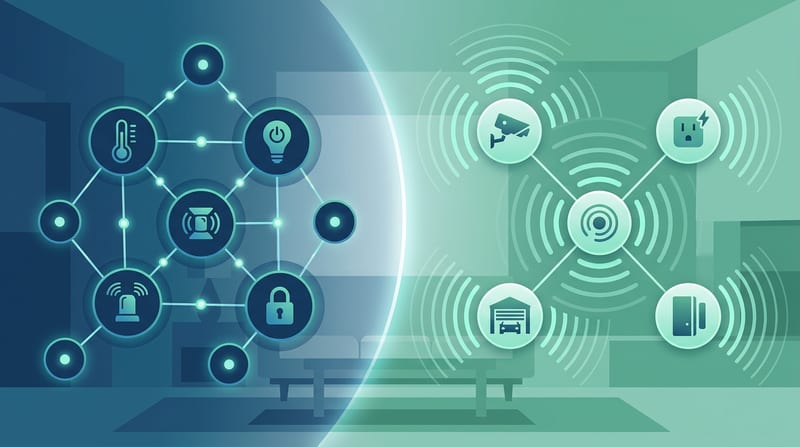
Zigbee vs Z-Wave: The Protocols Running Your Smart Home
Zigbee vs Z-Wave is a radio-layer execution decision that locks in range, interference tolerance, and mesh reliability for the life of your install. The 908 MHz sub-GHz choice versus 2.4 GHz creates non-negotiable tradeoffs in penetration, latency, and coordinator computational overhead that most comparison tables ignore.
Myth: Zigbee and Z-Wave are interchangeable mesh protocols that deliver equivalent real-world performance. Evidence: The physical layer differences drive measurable gaps in wall penetration, hop latency, and DSP/RTOS demands on the coordinator. Practical takeaway: Map your building materials, WiFi density, and tolerance for configuration work before buying the first device. The wrong choice creates daily friction that no firmware update will fully solve.
908 MHz vs 2.4 GHz: The Radio Decision That Dictates Everything Else
- Z-Wave operates at 908.4 MHz in the US, delivering superior drywall, brick, and floor penetration with fewer interfering devices.
- Zigbee uses the 2.4 GHz band (16 channels, 250 kbps) - the same spectrum as WiFi, microwaves, and Bluetooth.
- Z-Wave Long Range achieves direct connections up to 4000 feet in star topology, eliminating hops for distant sensors or outbuildings.
The longer wavelength of sub-GHz gives Z-Wave cleaner communication paths. Commands reach z wave thermostats in distant rooms with fewer retries. Zigbee compensates with dense mesh capability where every mains-powered device can act as a router, but this requires deliberate planning.
What's Z-Wave? Z-Wave refers to a sub-GHz mesh networking protocol using 908 MHz in the US (100 kbps) with strict certification requirements. It prioritizes reliability and interoperability over device volume. (IEEE 802.15.4 (Thread/Zigbee Physical Layer), 2025)
What's Zigbee? Zigbee refers to an IEEE 802.15.4-based 2.4 GHz mesh protocol offering 250 kbps throughput and theoretical support for 65,000 nodes. It delivers lower per-device cost and massive ecosystem scale at the expense of spectrum congestion management. (Connectivity Standards Alliance - Matter, 2025)
Zigbee vs Z-Wave 2026: Execution Tradeoffs That Matter
Zigbee mesh hop latency runs 10 - 30 ms per hop. A command crossing four hops accumulates 40 - 120 ms total latency. This becomes perceptible with motorized shades or security triggers. Z-Wave Long Range avoids this penalty for devices within direct range.
- Both protocols use AES-128 encryption and self-healing meshes.
- Z-Wave requires mandatory certification - implementation quality is more consistent.
- Zigbee is more open, leading to greater variation in how different vendors implement the stack.
Zigbee mesh hop latency: 10-30ms per hop versus Z-Wave Long Range’s direct-link performance creates the primary execution constraint for time-sensitive applications.
The Embedded Implementation Reality Most Reviews Ignore
The coordinator isn't a simple radio. It runs an RTOS managing mesh routing, timing, and device sleep schedules under hard real-time constraints.
- FreeRTOS runs on an estimated 40%+ of all embedded MCUs with an RTOS. (FreeRTOS Developer Documentation, 2025)
- ARM Cortex-M4 remains the sweet spot for most IoT coordinators - DSP instructions, hardware FPU, and $1 - $3 per chip. (ARM Cortex-M4 Technical Reference Manual, 2024)
- ESP32-S3 offers dual Xtensa LX7 cores at 240 MHz with vector instructions specifically for on-device ML and efficient interrupt handling. (Espressif ESP32-S3 Technical Reference Manual, 2025)
"FreeRTOS dominance isn't because it's the best RTOS. It's because it's free, well-documented, and runs on everything. Good enough wins in embedded." - Richard Barry, creator of FreeRTOS, Principal Engineer at AWS (AWS re:Invent keynote, 2023).
Worst-case interrupt latency on ESP32-S3 with FreeRTOS sits around 3 μs. These timings matter when your coordinator must maintain timing for dozens of sleeping end devices while processing incoming reports.
Zigbee vs Z-Wave Device Ecosystem and Cost Reality
Zigbee wins on selection and price. Sensors often start at $8 - 12. Z-Wave devices typically cost 2 - 3× more but deliver tighter interoperability guarantees.
Matter 1.4 (released November 2024) now includes 2,800+ certified devices and adds energy management support. Matter functions as an application layer running over Thread or WiFi - not directly over classic Zigbee or Z-Wave. (Connectivity Standards Alliance - Matter, 2025)
"Every smart home protocol claims to be the last one you'll ever need. Zigbee said it. Z-Wave said it, and Now Matter says it. The difference is that Matter has Apple, Google, and Amazon all pushing it simultaneously." says Stacey Higginbotham, IoT journalist and founder of Stacey on IoT (Stacey on IoT podcast, Episode 472, 2024).
Smart Thermostat Integration Gap
Heating and cooling accounts for approximately 43% of a typical U.S. home’s total energy use, making the thermostat the highest-impact node. Yet most smart thermostats use WiFi rather than mesh protocols.
ENERGY STAR connected thermostat certification requires real-world field data from thousands of units - not lab testing. Homes upgrading from existing programmable thermostats typically see only 2 - 3% additional savings from smart features. C-wire retrofit costs of $90 - $140 affect roughly 1 in 3 American homes and are rarely disclosed upfront. The NREL study highlights the near-total lack of standardized connected controls for ductless minisplits and room air conditioners.
2026 Decision Framework: Operator-First Selection
Dense apartments and condos with heavy 2.4 GHz congestion: Choose Z-Wave unless you're willing to perform careful Zigbee channel planning (channels 15, 20, or 25) and strategic router placement.
Large properties or outbuildings: Z-Wave Long Range delivers direct connectivity without relying on powered routers across distance.
New construction: Start with Matter over Thread using ESP32-C6 or ESP32-H2 chips. Bridge existing Zigbee devices rather than rip them out.
Existing installations with 20+ devices: Stay on your current protocol. Home Assistant (1 million+ active installations) supports both simultaneously via separate USB coordinators. (Home Assistant Statistics, 2025)
"The open-source community has built something with Home Assistant that no single company could have built alone. Two million installations in 2025 proves the demand for local, private smart home control." says Paulus Schoutsen, founder of Home Assistant / Nabu Casa (Home Assistant 2025.5 release blog, May 2025).
Zigbee vs Z-Wave Comparison Table
| Factor | Zigbee | Z-Wave Long Range | Practical Impact |
|---|---|---|---|
| Frequency | 2.4 GHz | 908 MHz (US) | Wall penetration & interference |
| Data Rate | 250 kbps | 100 kbps | Payload size vs congestion |
| Hop Latency | 10 - 30 ms per hop | Direct link (no hops in range) | Responsiveness of shades/lights |
| Max Nodes | 65,000 | 4,000 (LR star) | Irrelevant for most homes |
| Certification | More open | Strict mandatory | Implementation consistency |
| Typical Device Cost | Lower | 2 - 3× higher | Scale vs reliability budget |
Bottom line: Measure your environment first. If your walls block 2.4 GHz signals, sub-GHz wins. If device selection, price, and mesh density matter more, Zigbee remains the higher-volume choice. The protocol that disappears into the background is the one whose physical and computational constraints best match your specific installation reality.
Implement the mesh like you would critical infrastructure - with intention, measurement, and awareness of the tradeoffs. The sensors that report on time and the switches that respond without delay are the ones built on correctly chosen foundations.