The Signal Processing Behind Voice Assistants: Alexa, Siri, and Google Home
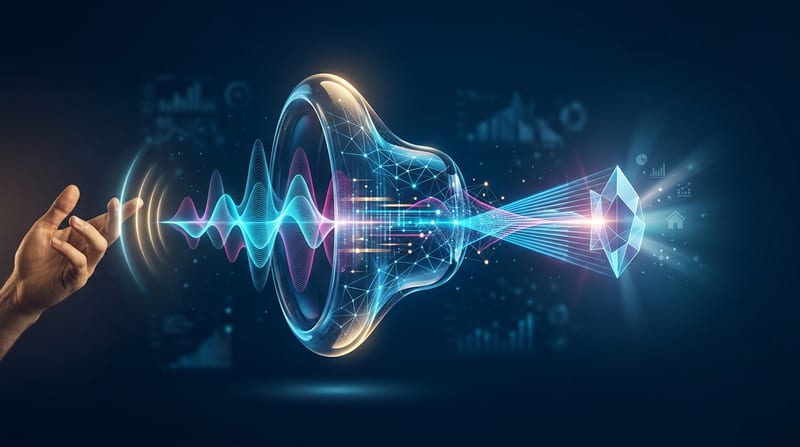
The signal processing behind voice assistants determines whether Alexa, Siri, or Google Home respond instantly and accurately or become frustratingly unreliable in real rooms. Local DSP handles always-on wake-word detection at milliwatt power levels while cloud models manage full automatic speech recognition after the trigger.
Wake word detection refers to the always-on local DSP process that identifies specific phrases using tiny 200 - 500 KB models consuming 1 - 2 mW. It fires an interrupt to activate the rest of the pipeline only when the target phrase is matched, keeping continuous power draw extremely low while maintaining acceptable accuracy.
How Microphone Arrays and ADC Front-Ends Shape Voice Assistant Performance
MEMS microphone count and ADC quality set the ceiling for every downstream algorithm. Distortion or insufficient dynamic range introduced here can't be fully corrected later.
Most devices sample at 16 kHz with 24-bit resolution for 144 dB dynamic range. Audio equipment uses 24-bit (144dB dynamic range) while many other IoT devices rely on 12-bit converters. The ADC front-end noise floor directly limits far-field performance.
Acoustic echo cancellation must run continuously at 16 kHz, modeling room acoustics with adaptive filters to subtract the device’s own speaker output. This operation consumes significant DSP resources yet must remain stable during loud music or TV playback.
How Wake Word Detection Works Locally on Embedded Hardware
The always-on core performs keyword spotting using a Mel-Frequency Cepstral Coefficient (MFCC) pipeline. It applies windowing, a 512-point FFT, mel filterbank, logarithm, and DCT every 10 - 25 ms.
A 512-point FFT on ESP32-S3 using the vector unit takes ~50 μs. On STM32F4 using CMSIS-DSP the same operation requires ~120 μs. (Espressif ESP32-S3 Technical Reference Manual, 2025)
Many implementations use the ARM Cortex-M4, which draws roughly 100 μW/MHz and costs $1 - $3 per chip.
"ARM Cortex-M4 with hardware FPU hit the sweet spot for IoT: fast enough for DSP, cheap enough for volume, power-efficient enough for battery," says Chris Shore, VP Marketing at ARM IoT Division (ARM DevSummit 2024). (ARM Cortex-M4 Technical Reference Manual, 2024)
The hardware FPU and DSP instructions accelerate feature extraction without draining standby power.
What Happens After the Wake Word Trigger: Cloud ASR Latency Budget
After detection, the system streams audio chunks to the cloud. Network latency dominates the typical 500 ms - 2 s round trip for partial transcripts and intent parsing.
Cloud models still outperform on-device alternatives for accents, background noise, and complex phrasing in 2026. However, on-device processing continues to expand for privacy and responsiveness.
RTOS Requirements for Real-Time Audio Processing
Audio frames must meet hard 33 ms deadlines at 30 fps equivalent timing. An RTOS guarantees bounded latency for these tasks.
FreeRTOS runs on an estimated 40%+ of all embedded MCUs with an RTOS. Worst-case interrupt latency on FreeRTOS with the ESP32-S3 sits around 3 μs. (FreeRTOS Developer Documentation, 2025)
"FreeRTOS dominance isn't because it's the best RTOS. It's because it's free, well-documented, and runs on everything. Good enough wins in embedded," says Richard Barry, creator of FreeRTOS, Principal Engineer at AWS (AWS re:Invent keynote, 2023).
Alexa vs Siri vs Google Home: DSP Implementation Differences
| Feature | HomePod (2nd Gen) | Echo (4th Gen) | Nest Hub (2nd Gen) |
|---|---|---|---|
| Microphone count | 6 | 4 - 7 | 4 |
| Primary SoC | A-series with custom NPU | AZ2 Neural Edge Processor | TPU-lite variant |
| AEC approach | Mask-based multichannel | Far-field + near-field chains | ML-backed beamforming |
| On-device capability | Limited local NLU | Some wake-word + NLU | Expanded on-device NLU |
HomePod emphasizes multichannel mask-based filtering. Echo’s AZ2 moves additional neural tasks on-device. Google focuses on ML-backed beamforming with growing on-device natural language understanding.
Why Real-World Performance Often Differs from Spec Sheets
Beamforming gain drops sharply beyond 3 meters as reverberation dominates. HVAC broadband noise and TV crosstalk expose the limits of even well-designed pipelines.
Placement and room acoustics frequently matter more than hardware price. A $50 Echo Dot in an optimal location can outperform a $300 HomePod in a noisy kitchen.
The Shift Toward On-Device Processing in 2026
Edge models continue improving latency and privacy. Apple Intelligence runs a 3B-parameter on-device model for certain tasks. Home Assistant has crossed 1 million active installations and supports local speech-to-text via Whisper. (Home Assistant Statistics, 2025)
"The open-source community has built something with Home Assistant that no single company could have built alone. Two million installations in 2025 proves the demand for local, private smart home control," says Paulus Schoutsen, founder of Home Assistant / Nabu Casa (Home Assistant 2025.5 release blog, May 2025).
The ESP32-S3 includes a vector instruction unit designed specifically for on-device wake-word detection and simple ML inference. BOM cost sits between $2.50 and $3.50. (Espressif ESP32-S3 Technical Reference Manual, 2025)
"We designed the ESP32-S3 vector instruction unit specifically to enable on-device wake-word detection and simple ML inference. The goal was a $3 chip that can listen, not just connect," says Teo Swee Ann, CEO and founder of Espressif Systems (Espressif Developer Conference 2024).
Matter now includes over 2,800 certified devices and runs over Thread using the IEEE 802.15.4 physical layer. (Connectivity Standards Alliance - Matter, 2025) (IEEE 802.15.4 (Thread/Zigbee Physical Layer), 2025)
Zephyr has become the fastest-growing RTOS alternative with 450+ supported boards. (Zephyr Project - Supported Boards, 2025)
How to Choose a Voice Assistant Based on DSP Quality
- Test AEC during music and TV playback - strong echo cancellation during loud audio separates usable devices from frustrating ones.
- Prioritize microphone array performance in your actual room - beamforming quality and placement matter more than advertised mic count.
- Evaluate on-device capability for your privacy needs - local wake-word and NLU reduce cloud dependency and latency.
- Consider local alternatives - Home Assistant with Whisper offers fully local voice control on modest hardware for users who want zero cloud audio streaming.
The DSP implementation ultimately decides whether a voice assistant feels responsive or unreliable in your environment. Focus on real-world acoustic echo cancellation, far-field performance in your specific noise conditions, and your tolerance for cloud processing rather than marketing claims about "AI features."
Prioritize devices that maintain low false-positive rates while preserving fast response times. The combination of quality MEMS arrays, clean ADC front-ends, efficient always-on DSP, and thoughtful AEC delivers the highest decision confidence for long-term satisfaction.