The Engineering Behind Solar Inverters: How Signal Processing Maximizes Output
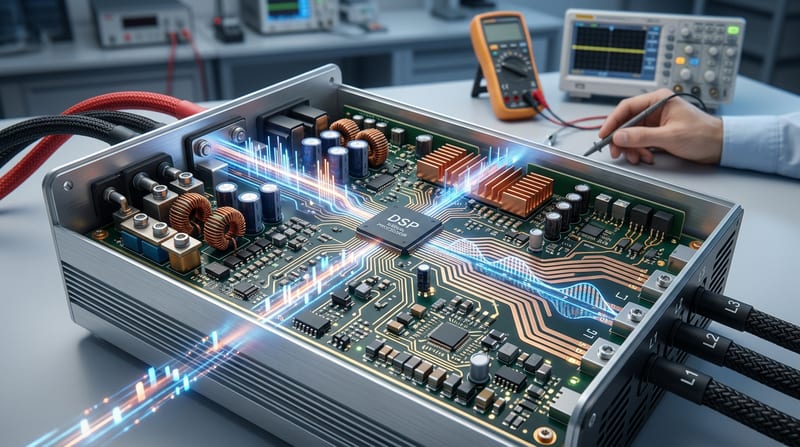
The inverter DSP determines actual energy harvest far more than panel wattage ratings. Signal processing executes the MPPT algorithm, maintains grid synchronization via the PLL, performs anti-islanding detection, and manages DC to AC conversion solar in real time under rapidly changing conditions. These computations directly set annual yield, reliability, and safety compliance.
The Core Problem: Variable Irradiance Meets Strict Grid and Safety Requirements
Solar arrays experience constant changes in irradiance, temperature, and grid conditions. The inverter must extract maximum power, maintain power quality, and disconnect safely within 2 seconds during islanding per IEEE 1547. These simultaneous demands create hard execution constraints on the DSP.
Computational Budget Constraints Force Clear Tradeoffs
Anti-islanding detection alone consumes 5 - 15% of the DSP computational budget. Arc fault detection per NEC 690.11 requires real-time spectral analysis of DC current waveforms scanning for 100 kHz - 1 MHz signatures. This requirement drives migration from 8-bit chips to 32-bit ARM Cortex-M0+ and RISC-V processors at the panel level. Every cycle allocated to safety reduces headroom for efficiency optimization.
TI C2000 Real-Time MCUs (TI C2000 Real-Time MCU Product Line, 2024)
Texas Instruments C2000 series MCUs power 80%+ of residential solar inverters. The TMS320F28379D dual-core device handles MPPT, PLL, and PWM generation at kilohertz rates with BOM cost of $8 - $12. This specific hardware foundation explains why firmware quality now separates leading inverters from commodity units.
Sensorless MPPT: Removing Hardware While Maintaining Accuracy
Traditional MPPT relied on dedicated irradiance sensors costing $15 - $40 per installation point plus ongoing calibration risk. Sensorless designs using neural networks now achieve sub-0.13V error and recover from disturbances in under 3 milliseconds. This eliminates both the component cost and a common failure mode while matching or exceeding sensor-based accuracy.
What's MPPT in Solar Inverters?
MPPT refers to Maximum Power Point Tracking, an algorithm that continuously adjusts operating voltage to extract maximum available power from PV arrays under varying irradiance and temperature. Modern implementations run at 100Hz - 10kHz on dedicated DSP hardware, achieving 99%+ tracking efficiency through either perturb-and-observe or advanced neural network approaches.
How the PLL Determines Power Factor and False Trip Rates
The Phase-Locked Loop must synchronize to grid voltage phase within 2 - 5 cycles (33 - 83ms at 60Hz) and track frequency deviations of ±0.5 Hz in real time. Poor PLL tuning causes current injection at incorrect phase angles, reducing power factor and triggering false anti-islanding events. This remains one of the least-discussed but most critical DSP blocks in residential inverters.
CEC Weighted Efficiency Hides Low-Light Performance
CEC weighted efficiency assigns 53% of its weight to the 75% load point and only 4% to the 10% load point. Inverters spend 40 - 60% of annual operating hours at low irradiance. This weighting means headline efficiency numbers often overstate real-world annual energy harvest by 2 - 5%. (NREL Solar Resource Data, 2025)
Module-Level Electronics Create the Real Reliability Bottleneck
The true reliability limit of a 25-year solar installation is the module-level electronics, not the panels. Power optimizers and microinverters carry 12 - 25 year warranties while panels carry 25 - 30 year performance warranties. Most homeowners will replace electronics at $30 - $60 per panel ($960 - $1,920 for a 32-panel system) at least once during the array lifetime. (SEIA / Wood Mackenzie Solar Market Report, 2025)
Parasitic Power Consumption Erodes Annual Yield
Module-level power electronics consume 0.5 - 2W per panel continuously during daylight hours. On a typical 32-panel residential array this equals 16 - 64W of constant self-consumption, costing 50 - 200 kWh/year or $7 - $28 annually depending on local rates. Most yield estimates omit this number entirely.
DC/AC Ratio Clipping as Deliberate Design Choice
Inverter clipping at DC/AC ratios of 1.2 - 1.4 is intentional. Well-designed systems using rate-limited power curtailment algorithms clip only 1 - 3% of annual energy while reducing cost-per-watt by 10 - 15%. The DSP firmware manages these transitions to prevent grid disturbances. Residential solar cost per watt averaged $2.70 - $2.95 in 2025 before the 30% ITC. (EnergySage Solar Marketplace Data, 2025)
Multilevel Inverter Tradeoffs
Multilevel topologies (cascaded H-bridge, neutral-point clamped) achieve <3% THD without output filters using 5 - 11 voltage levels. However they require 2 - 4× more switching devices and nanosecond-precision dead-time control across independent channels. This complexity confines them to utility-scale (>1 MW) applications rather than residential rooftops.
learn more Evaluate Inverter DSP Quality Before Purchase
- Request the partial-load efficiency curve - Focus on performance at 10% and 20% load where the system operates 40-60% of the time.
- Verify firmware update policy - Long-term support directly impacts both safety and efficiency over 25 years.
- Confirm MPPT channel count and voltage window match your array design and shading profile.
- Ask about dead-time control strategy and whether adaptive or resonant switching is implemented.
- Check processor architecture - Look for evidence of sufficient DSP headroom beyond basic requirements.
Grid-Forming vs Grid-Following: Emerging Requirement for Battery Systems
" The residential solar industry is fundamentally a power electronics industry. The panels are commoditized. The inverter is where all the intelligence lives, and microinverters changed the economics of shade tolerance permanently," says Badri Kothandaraman, CEO of Enphase Energy (Enphase Q3 2024 Earnings Call).
Battery-backup installations increasingly require grid-forming capability. The DSP architecture must support both grid-following and autonomous voltage/frequency regulation through virtual synchronous machine emulation. Not all inverters can switch modes seamlessly.
Recommendation: Prioritize Firmware and Low-Light Execution
Select inverters based on measured partial-load efficiency, long-term firmware support, and transparent documentation of PLL and MPPT implementation. The $8 - $12 DSP chip and its firmware determine whether your system delivers promised lifetime performance or silently underperforms by 2 - 5% annually.
The panels generate DC. The inverter DSP decides how much AC power reaches your meter and how reliably it does so for 25 years. Understanding these signal processing tradeoffs allows operators to specify systems that maximize both energy production and long-term ROI.
How Much Do Module-Level Electronics Actually Cost Over System Lifetime?
The average cost to replace module-level power electronics once during a 25-year installation is $960 - $1,920 for a 32-panel system. This expense is rarely discussed in initial sales proposals despite representing the primary reliability bottleneck.
Why Most Budget Panels Lack Embedded Intelligence
Standard budget solar panels still use purely passive Schottky bypass diodes. Active electronics appear primarily due to NEC 690.12 rapid shutdown requirements rather than inherent panel design. The compliance device is often a separate add-on module, not integrated in the junction box. This distinction matters for both cost and long-term maintenance planning.