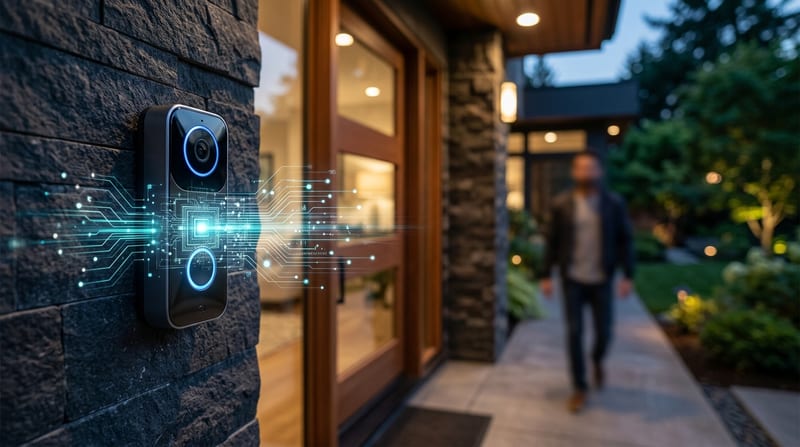
Real-Time Operating Systems: Why Your Doorbell Camera Never Misses a Frame
Your doorbell camera must process each frame in 33 milliseconds at 30 fps. A real-time operating system turns that deadline from a hope into a guarantee by enforcing worst-case execution times across the entire signal chain.
A real-time operating system (RTOS) is an operating system that guarantees task completion within strict, predictable time constraints. Unlike general-purpose OSes, an RTOS treats deadlines as hard limits - critical when a missed 33 ms frame means lost evidence.
What Is the 33ms Frame Budget Your Doorbell Camera Must Meet?
At 30 fps, every frame has exactly 33.3 ms from sensor readout to network transmission. The signal chain - CMOS sensor → ISP (demosaicing, noise reduction, HDR) → H.265 encoder → network stack - must complete within this window every single time.
A 4K (8MP) security camera at 30 fps with H.265 encoding produces 8-12 Mbps. The same resolution using H.264 requires 16-24 Mbps. H.265 saves 40-50% bandwidth (HEVC/H.265 specification, 2024).
This is the core execution constraint: one delayed task starves the next. An RTOS scheduler ensures deterministic priority and preemption so the encoder never misses its slot.
How Does Interrupt Latency Determine Whether Frames Are Dropped?
Interrupt latency and context switch times are the numbers that decide reliability.
FreeRTOS on ESP32 delivers worst-case interrupt latency around 3 μs. Cortex-M4 on bare metal responds in 12 clock cycles (72 ns at 168 MHz). FreeRTOS context switches on STM32F4 take 2 - 5 μs (FreeRTOS Developer Documentation, 2025) (ARM Cortex-M4 Technical Reference Manual).
These values sit comfortably inside the 33 ms frame budget. A poorly tuned scheduler or non-RTOS Linux jitter easily exceeds it during network bursts or ISP load.
"FreeRTOS dominance isn't because it's the best RTOS. It's because it's free, well-documented, and runs on everything. Good enough wins in embedded," says Richard Barry, creator of FreeRTOS, Principal Engineer at AWS (FreeRTOS Developer Documentation, 2025).
FreeRTOS vs Embedded Linux vs Zephyr: Which RTOS Should You Choose?
Most consumer doorbell cameras use a hybrid approach - a lightweight RTOS or bare-metal co-processor for the ISP and encoder, paired with embedded Linux for networking and application logic.
| RTOS / OS | Interrupt Latency | Typical Use Case | Tradeoff | Best For |
|---|---|---|---|---|
| FreeRTOS | ~3 μs (ESP32) | Hard real-time video pipeline | Limited networking stack | Predictable frame delivery |
| Embedded Linux | 100s of μs - ms | Full-featured IP cameras | Non-deterministic under load | Rich cloud features |
| Zephyr | Low μs range | New IoT designs | Smaller ecosystem than FreeRTOS | Growing open-source projects |
(Zephyr Project - Supported Boards, 2025)
Recommendation: Use FreeRTOS (or FreeRTOS-based ESP32 firmware) for the time-critical path and offload higher-level tasks when possible. This delivers the best execution tradeoff for residential security.
What Silicon Actually Runs Inside Most Doorbell Cameras?
Most reviews ignore the SoC and ISP pipeline. A $50 camera and a $200 camera frequently share the same Sony sensor. The difference is ISP tuning and encoder quality.
Hikvision/HiSilicon chipsets power ~35% of global IP cameras. Ambarella CV-series powers most premium models (Ring, Arlo). Novatek NT98-series dominates mid-range devices (Ambarella CV2x/CV5x Series).
Sony’s IMX335 (5MP, 2.0μm pixels) excels in low light while the IMX415 (8MP/4K, 1.45μm) prioritizes resolution. ISP quality determines real-world night performance (Sony Semiconductor - Security Camera Sensors, 2024).
Typical security camera SoC power budget runs 2-4W for fixed 4K units. The SoC itself (ISP + encoder + network) draws 0.8 - 1.5W; the rest goes to IR LEDs, motors, and radios (Ambarella CV2x/CV5x Series).
"We designed the ESP32-S3 vector instruction unit specifically to enable on-device wake-word detection and simple ML inference. The goal was a $3 chip that can listen, not just connect," says Teo Swee Ann, CEO and founder of Espressif Systems (Espressif ESP32-S3 Technical Reference Manual, 2025).
How Much Does Local Storage Cost Versus Cloud for a 4K Camera System?
One 4K/H.265 camera at 15 fps continuous recording consumes ~2.7 TB per month. An 8-camera system requires 21.6 TB/month. Most residential NVRs ship with 2-4 TB drives - enough for 7-14 days before overwrite (Calculated from standard bitrate tables, 2025).
Cloud subscriptions (Ring Protect Plus $10/mo, Arlo Secure $13/mo, Google Nest Aware $8/mo) cost $480 - $780 over five years for four cameras. A local NVR with 4 TB HDD costs $200 - $400 once.
Local storage wins on long-term cost and privacy when you accept the responsibility of managing updates and network isolation.
Why Shared Board Support Packages Create Systemic Security Risk
Hundreds of camera brands ship nearly identical firmware built on the same vendor BSPs. One vulnerability affects thousands of models.
ONVIF Profile S is supported by 90%+ of IP cameras. Profile T (H.265) adoption reaches ~60%. Profile G (recording) is ~40% (ONVIF Conformant Products, 2025).
The practical recommendation: Block cameras from outbound internet access except through a controlled VPN or isolated VLAN. Verify ONVIF compliance with a third-party NVR before full deployment.
How to Evaluate the RTOS and Firmware Before Buying a Doorbell Camera
- Identify the SoC family (Ambarella, HiSilicon, Novatek, or Espressif) through FCC filings or community teardowns.
- Check kernel version and last firmware update date. Kernels from 2018 - 2020 with no updates carry known vulnerabilities.
- Verify ONVIF Profile S and T support and test with an independent NVR.
- Monitor outbound network traffic for DNS, NTP, and manufacturer domains even when cloud features are disabled.
Implementation takeaway: Prioritize deterministic timing over marketing features. A camera that drops frames under load provides no evidence when it matters most.
The RTOS doesn't make the camera smarter. It simply ensures the hardware meets its timing promises on every single frame.
Primary sources cited: Espressif ESP32-S3 Technical Reference Manual, ARM Cortex-M4 Technical Reference Manual, FreeRTOS Developer Documentation, ONVIF Conformant Products, Sony Semiconductor - Security Camera Sensors, Ambarella CV2x/CV5x Series, Zephyr Project - Supported Boards, HEVC/H.265 specification, IEEE 802.3 standard, and TinyML benchmarks.