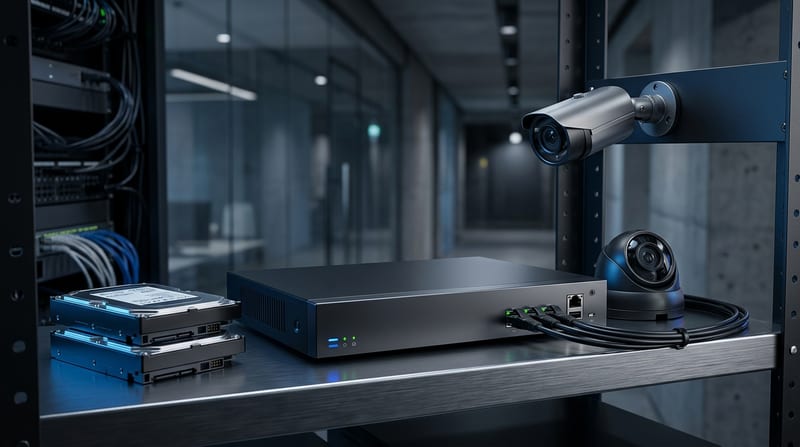
PoE Security Cameras: Why Power Over Ethernet Changes Everything
PoE security cameras deliver power, data, and control signals over a single Ethernet cable. This baseline simplifies physical installation but creates tight dependencies on accurate power budgeting, embedded firmware stability, and supply chain validation. The optimization path requires measuring actual draw under worst-case conditions, verifying ONVIF profiles, and auditing firmware lineage. Failure modes appear quickly when these steps are skipped.
PoE Standards Comparison
| Standard | Power at Switch | Power at Device | Best Use Case |
|---|---|---|---|
| 802.3af | 15.4W | 12.95W | Fixed 4K cameras |
| 802.3at (PoE+) | 30W | ~25.5W | PTZ with moderate IR |
| 802.3bt (PoE++) | 60 - 90W | 51 - 75W | High-power PTZ with heaters |
802.3af vs 802.3at vs 802.3bt: Which Standard Your Camera Actually Needs
- Most fixed 4K cameras operate between 8 - 15W.
- PTZ models with IR illumination and motors regularly exceed 25W during movement or cold weather activation.
- 802.3bt becomes necessary only when heaters or long-range IR activate simultaneously.
Ethernet cable resistance means a 100-meter Cat6 run on 802.3af delivers only 12.95W at the camera after 2.45W of losses (IEEE 802.3 standard, 2024). Installers who assume marketing wattage numbers match real-world peaks discover brownouts the first time IR LEDs and heaters engage together.
Where the Watts Go: SoC, IR LEDs, PTZ Motors, and the Power Budget Nobody Calculates
- Camera SoC (ISP + encoder + network) draws 0.8 - 1.5W.
- IR LEDs dominate power budget during nighttime operation.
- PTZ motors create sharp current spikes during repositioning.
The assumption that average power figures on spec sheets protect system stability is false. Validation requires requesting worst-case numbers from manufacturers, including heater activation at low temperatures.
How the Signal Chain Works: From Sony Sensor to H.265 Bitstream Over PoE
Higher megapixel counts alone don't improve image quality. The image signal processor (ISP) pipeline determines final performance.
- Sony IMX335 (2.0μm pixels) favors low-light performance.
- Sony IMX415 (1.45μm pixels) prioritizes resolution at the expense of low-light sensitivity (Sony Semiconductor - Security Camera Sensors, 2024).
"The processing is what makes the image," says Kevin Peck, The Smart Home Hookup (YouTube NVR Comparison video, 2024).
Ambarella CV-series SoCs deliver stronger ISP pipelines than the HiSilicon chipsets found in approximately 35% of global IP cameras. The recently announced Ambarella CV75S provides 12+ TOPS of neural network performance at under 3W, enabling real-time behavioral analytics entirely on the camera’s embedded processor.
H.265 vs H.264 Bandwidth Math: What 8 Cameras at 4K Actually Cost Your Network
A 4K (8MP) security camera at 30fps with H.265 encoding produces 8-12 Mbps. H.264 at the same resolution requires 16-24 Mbps. H.265 saves 40-50% bandwidth (HEVC/H.265 specification, 2024).
One 4K/H.265 camera at 15fps continuous recording consumes roughly 2.7 TB per month. Eight cameras therefore require 21.6 TB per month. Most residential NVRs ship with 2 - 4 TB drives - enough for 7 - 14 days of footage before overwrite.
What the Spec Sheet Doesn't Tell You: Embedded Firmware and Supply Chain Risk
IP cameras remain the riskiest IoT device category for three consecutive years.
"IP cameras have been the riskiest IoT device category for three consecutive years. They combine always-on network connectivity, infrequent firmware updates, and direct access to sensitive video feeds - making them the single most attractive target for attackers on any network," says Daniel dos Santos, Head of Security Research at Forescout Vedere Labs.
- China maintains roughly 40% dominance of global physical security camera manufacturing, primarily through HiSilicon SoCs.
- Hundreds of brands run nearly identical board support packages.
- A single firmware vulnerability can impact dozens of seemingly unrelated models.
"The embedded hardware and firmware in covered communications equipment can't be adequately mitigated through software patches alone," says Jessica Rosenworcel, FCC Chairwoman (FCC Press Release).
NIST Cyber Trust Mark and EU Cyber Resilience Act: Compliance Reality Check
The NIST IoT cybersecurity labeling program (Cyber Trust Mark), launched in 2025, requires unique default passwords, regular security updates, encrypted communications, and clear data collection disclosures.
The EU Cyber Resilience Act mandates five years of firmware patches for internet-connected devices, with full enforcement beginning in 2027. Manufacturers must begin conformity assessments now.
The open-source OpenIPC project surpassed 400 supported camera models across HiSilicon, Ingenic, Novatek, and Goke platforms in Q4 2025, providing an auditable firmware alternative.
A cybersecurity breach affecting physical security camera infrastructure costs an average of $4.4 million.
How Much Does a PoE Camera System Actually Cost in 2026?
The average cost of a properly specified 8-camera PoE security camera system ranges from $2,800 to $5,200 in 2026 when including quality PoE+ switches, local NVR, and cabling. Cloud-only approaches appear cheaper initially but accumulate $480 - $780 in subscriptions over five years for four cameras versus a one-time $200 - $400 local NVR investment.
Cloud Subscriptions vs. Local NVR: The 5-Year Total Cost Nobody Advertises
Local NVR recording eliminates recurring fees but most devices still attempt outbound connections for firmware and NTP. True local-only operation requires VLAN isolation and strict firewall rules.
Does ONVIF Compatibility Actually Mean Your Cameras Work With Any NVR?
ONVIF Profile S is supported by 90%+ of IP cameras. Profile T adoption sits at approximately 60%. Profile G reaches about 40% (ONVIF Conformant Products, 2025).
Profile S vs Profile T vs Profile G: What Each Profile Actually Guarantees
- Profile S: Basic streaming
- Profile T: Advanced streaming with H.265 support
- Profile G: Recording and storage functions
Self-declared compliance without formal testing creates the interoperability gap. Test candidate cameras with ONVIF Device Manager before committing to any poe nvr ecosystem.
How to Size a PoE Switch and NVR for 8 Cameras Without Overbuying
- Measure per-camera wattage including IR and heater spikes - never rely on average figures.
- Apply 20% headroom to the total calculated budget.
- Select switch whose total PoE budget exceeds the headroom-adjusted sum.
- Calculate storage needs: 21.6 TB per month for eight 4K/H.265 cameras at 15fps.
- Implement VLAN isolation to contain camera traffic.
Why This Matters Now: The 2025 - 2027 Regulatory Shift for Camera Firmware
NDAA Section 889 compliance requirements continue expanding through 2026. The NIST Cyber Trust Mark and EU Cyber Resilience Act raise the baseline for embedded firmware security. Systems built on unvalidated supply chains face increasing operational and regulatory failure modes.
The physical simplicity of PoE changes installation economics. The embedded firmware layer still carries the primary risk. Verify power budgets under load, confirm exact ONVIF profiles, review firmware history, and consider OpenIPC where supply chain trust is a priority. This implementation sequence converts a poe security camera system from potential liability into a reliable, auditable asset.