IoT Sensor Networks: How Embedded Systems Monitor Your Whole House
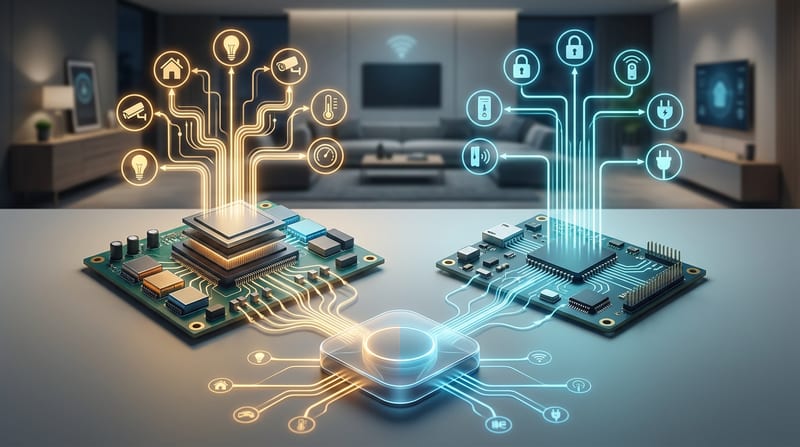
IoT sensor networks use embedded systems to monitor your whole house by processing data locally from cameras, environmental sensors, and solar equipment. Baseline deployments depend on opaque factory firmware running on shared chipsets, creating supply-chain risk and persistent vulnerabilities. The optimization path replaces that stack with auditable firmware, properly-specified SoCs, and local control via standards-compliant protocols. Failure mode checks require verifying chipset origin, firmware support lifecycle, and actual outbound traffic before installation.
What's an Embedded System in IoT Sensor Networks?
An embedded system in IoT sensor networks refers to a dedicated computing platform built around a System-on-Chip (SoC), DDR RAM, flash storage, and a real-time or embedded operating system that processes sensor data with strict timing constraints instead of sending raw streams to the cloud.
Most assume IoT sensors are simple passive devices. Evidence shows otherwise. IP cameras now represent 70% of all security camera shipments globally. This means 7 in 10 cameras sold contain a full embedded Linux system (SoC, DDR RAM, flash storage, network stack) rather than simple analog circuitry (WifiTalents Physical Security Camera Industry Report, 2026).
Why Most IoT Devices Remain Unpatched and Vulnerable
"IP cameras have been the riskiest IoT device category for three consecutive years. They combine always-on network connectivity, infrequent firmware updates, and direct access to sensitive video feeds - making them the single most attractive target for attackers on any network," says Daniel dos Santos, Head of Security Research at Forescout Vedere Labs (Forescout Riskiest Connected Devices Report, 2024).
Forescout data reveals that most connected devices fall outside traditional IT categories. They don't receive regular patches. They sit on your network with direct access to video feeds or environmental data. Concrete takeaway: Basic router rules can't fully address the persistent risk created by unmaintained embedded systems.
The BSP Problem: Why Hundreds of Camera Brands Share Identical Vulnerable Firmware
HiSilicon chipsets power about 35% of global IP cameras. One vulnerability in the vendor BSP affects dozens of brands that reuse the same firmware base. The practical validation step is simple: check the chipset before purchase rather than the brand name.
How the Signal Chain Works: From Sensor to SoC to Local Display
The signal chain determines whether your IoT sensor networks deliver usable data or noisy alerts. Each processing step must be validated against real-world requirements.
Camera Pipeline: Sony IMX Sensor → ISP → H.265 Encoder → RTSP Stream
A Sony IMX335 sensor offers 2.0μm pixels for better low-light performance. The IMX415 provides 1.45μm pixels at 4K resolution (Sony Semiconductor - Security Camera Sensors, 2024).
A 4K (8MP) security camera at 30fps with H.265 encoding produces 8-12 Mbps. H.264 at the same resolution requires 16-24 Mbps. H.265 saves 40-50% bandwidth (HEVC/H.265 specification, 2024). Concrete takeaway: Codec and ISP pipeline quality directly determines network load and local storage requirements.
PoE Power Budgets: Matching Hardware to Actual Requirements
| PoE Standard | Power at Port | Power at Device | Typical Use Case |
|---|---|---|---|
| 802.3af | 15.4W | 12.95W | Fixed 4K cameras |
| 802.3at (PoE+) | 30W | 25.5W | PTZ with IR |
| 802.3bt (PoE++) | 60-90W | 51-71W | High-power PTZ |
Most fixed cameras need 8-15W while PTZ units with IR and motors need 30-60W. The SoC itself draws only 0.8-1.5W (IEEE 802.3 standard, 2024). Concrete takeaway: Your switch must deliver the full specified power or the camera will reboot under load.
What SoC Is Inside Your Camera - and Why That Spec Matters More Than Resolution
Resolution numbers mislead buyers. The SoC determines what the camera can actually do with the pixels.
Ambarella announced the CV75S SoC in late 2025 targeting next-generation security cameras with 12+ TOPS of neural network inference performance at under 3W (Ambarella CV2x/CV5x Series). Budget Novatek NT98-series chips typically deliver 0.5-2 TOPS.
AI Detection Reality Check: TOPS vs Usable Performance
Sub-$100 cameras run tiny quantized models under 5MB. Higher-end chips with sufficient memory bandwidth run larger models locally without cloud dependency. Concrete takeaway: TOPS numbers are meaningless without confirming supported operations, memory bandwidth, and model compatibility.
Zigbee, Thread, Matter: Choosing the Right Stack for a Reliable Mesh Network Home
Protocol choice affects reliability more than feature lists suggest. Physical layer details determine whether your zigbee sensor network stays responsive under WiFi congestion.
| Protocol | Frequency | Topology | Latency | Primary Strength |
|---|---|---|---|---|
| Zigbee 3.0 | 2.4 GHz | Mesh | 10-30ms per hop | Large node count |
| Z-Wave Long Range | Sub-GHz | Direct | Low | Range without hops |
| Matter over Thread | 2.4 GHz | Mesh (IPv6) | Low | Cross-ecosystem |
"Every smart home protocol claims to be the last one you'll ever need. Zigbee said it. Z-Wave said it, and Now Matter says it. The difference is that Matter has Apple, Google, and Amazon all pushing it simultaneously," says Stacey Higginbotham, IoT journalist and founder of Stacey on IoT (Stacey on IoT podcast, Episode 472, 2024).
Matter 1.4 (released November 2024) added energy management and appliance support. Over 2,800 devices are now certified (Connectivity Standards Alliance - Matter).
learn more Achieve Smart Home Without Cloud Using Auditable Firmware
OpenIPC surpassed 400 supported camera models in Q4 2025 across HiSilicon, Ingenic, Novatek, and Goke SoCs. It enables replacement of factory firmware with transparent, auditable code.
Many budget cameras still ship with U-Boot, BusyBox, and kernels from the 2010s. Factory firmware often generates outbound DNS, NTP, and unencrypted telemetry even in "local" mode. Concrete takeaway: Blocking internet access to the device while maintaining functionality requires auditable firmware and careful network segmentation.
The RTOS Layer: Why Timing Matters in IoT Sensor Networks
A light switch tolerates occasional delays. A security camera processing 30fps video has a 33ms frame budget. Missing frames means lost evidence.
FreeRTOS runs on an estimated 40%+ of all embedded MCUs with an RTOS (FreeRTOS Developer Documentation). ESP32-S3 worst-case interrupt latency on FreeRTOS is approximately 3μs. Cortex-M4 on bare metal achieves 72ns at 168MHz (ARM Cortex-M4 Technical Reference Manual).
"FreeRTOS dominance isn't because it's the best RTOS. It's because it's free, well-documented, and runs on everything. Good enough wins in embedded," says Richard Barry, creator of FreeRTOS, Principal Engineer at AWS (AWS re:Invent keynote, 2023).
How Much Does a Whole-House IoT Sensor Network Cost in 2026?
The average cost of a basic whole-house IoT sensor network is $2,000 in 2026 for hardware with 8 cameras, environmental sensors, and basic solar monitoring, with a typical range of $1,500-$5,000 depending on local storage and edge-AI choices.
Cloud storage subscription costs for security cameras run $8 - 13 per month. Over 5 years, a 4-camera cloud system costs $480-$780 in subscriptions alone. A local NVR with 4TB HDD costs $200-$400 once. One 4K/H.265 camera at 15fps continuous recording uses ~2.7 TB/month. Eight cameras require 21.6 TB/month (ONVIF Conformant Products, 2025).
Home Assistant crossed 1 million active installations and supports 2,400+ integrations. It runs effectively on a Raspberry Pi 4 or dedicated hardware for local control and monitoring (Home Assistant Statistics).
Regulatory Walls Closing In: What Compliance Means for New Deployments
The EU Cyber Resilience Act (Regulation 2024/2847) requires manufacturers of internet-connected devices - including IP security cameras - to provide embedded firmware security patches for a minimum of 5 years. NIST’s IoT cybersecurity labeling program (Cyber Trust Mark), launched in 2025, sets baseline requirements for unique default passwords, regular updates, encrypted communications, and data disclosures.
"New rules will prohibit the authorization of equipment that poses an unacceptable risk to our national security. The embedded hardware and firmware in covered communications equipment can't be adequately mitigated through software patches alone," says Jessica Rosenworcel, FCC Chairwoman.
Implementation Checklist: From Baseline to Optimized Local System
- Identify the actual SoC and sensor model before purchase.
- Verify minimum 5-year firmware support window.
- Choose ONVIF Profile T or higher for H.265 streaming.
- Deploy local NVR or Home Assistant-based recording.
- Replace factory firmware with OpenIPC where supported.
- Block all unnecessary outbound connections at the router.
- Validate actual power delivery matches PoE standard requirements.
Final Takeaway
The brand name on the box is marketing. The SoC, firmware provenance, and network architecture are the product. By treating IoT sensor networks as the embedded systems they actually are - rather than simple plug-and-play appliances - homeowners achieve lower long-term cost, stronger privacy, and more reliable operation than cloud-dependent baseline deployments.