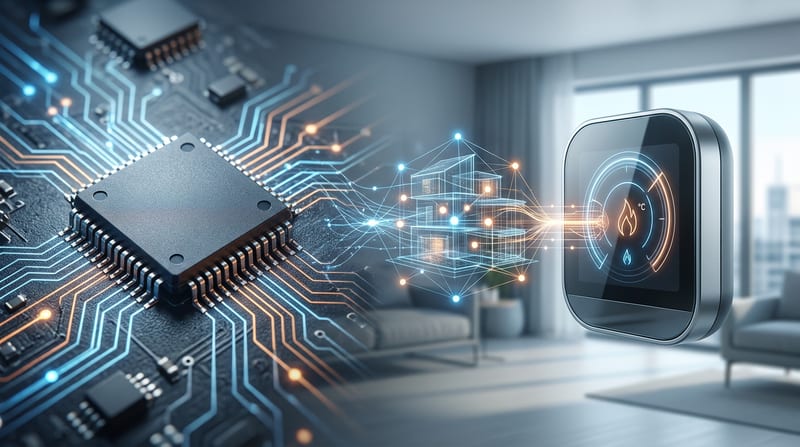
From Microcontrollers to Smart Thermostats: The Tech Inside Your HVAC
Heating and cooling represent 43% of a typical U.S. home’s energy consumption. The device controlling every cycle is no longer a simple switch - it's a microcontroller running real-time control algorithms. From microcontrollers to smart thermostats, the shift to embedded intelligence directly affects your monthly bills, installation costs, and long-term reliability in 2026.
What's a Smart Thermostat?
A smart thermostat is a PID control loop thermostat that combines temperature and humidity sensors, an ARM Cortex-M4 or similar MCU, wireless connectivity, and firmware that continuously calculates error, integral, and derivative terms to maintain setpoint. Unlike basic programmable models, it uses occupancy data and predictive logic to minimize unnecessary HVAC cycles.
The myth that every smart thermostat delivers 8 - 10% savings collapses under evidence. ENERGY STAR certification requires real-world field data from thousands of installed units - the only category with this standard. That 8% figure assumes replacement of a basic manual thermostat. Homeowners upgrading from an existing programmable thermostat typically see only 2 - 3% additional savings. (EPA ENERGY STAR Connected Thermostat Program, 2025).
Practical takeaway: Measure your baseline thermostat type before purchase. The firmware upgrade matters far more than the brand name.
How Does a Smart Thermostat Work?
The signal chain begins with a 12-bit temperature/humidity sensor producing an analog voltage. This feeds an ADC, which passes digital values to the microcontroller. Firmware then executes a PID control loop thermostat that calculates proportional, integral, and derivative terms. The output drives relays or triacs that control the HVAC equipment. Occupancy sensors and external weather data adjust setpoints proactively.
A teardown of a $250 smart thermostat reveals approximately $25 - $40 in bill-of-materials: an ARM Cortex-M4 MCU ($2), WiFi/BLE SoC ($3), 12-bit temperature/humidity sensor (~$1.50), small display, relay board, and passives. The remaining $210+ covers cloud infrastructure, R&D amortization, industrial design, and margin. (ARM Cortex-M4 Technical Reference Manual, 2024).
Practical takeaway: The hardware is inexpensive. The quality of the PID tuning and firmware determines whether you actually save money or simply pay a premium for marketing.
How Much Does a Smart Thermostat Cost to Install in 2026?
The average cost of professional smart thermostat installation is $184 - $200 in 2026, including the device, labor, and basic testing. Complex retrofits with new wiring reach $300 - $500. (Keemeet HVAC Thermostat Cost Analysis, 2026).
The $90 - $140 C-wire retrofit cost affects roughly 1 in 3 American homes and is almost never disclosed in smart thermostat marketing. Without a C-wire, many units refuse installation, fall back to battery mode with degraded WiFi, or require a power extender kit that adds another failure point. (CountBricks U.S. Construction Cost Database, 2026).
Practical takeaway: Always verify existing wiring before purchase. Budget for the C-wire retrofit in older homes to avoid degraded performance.
Why the C-Wire Trap Still Catches Homeowners
Homes without a C-wire face real constraints. Battery-powered fallback reduces connectivity reliability. Power extender kits introduce additional failure points. HVAC technicians typically charge $65 - $100 per hour for this extra work.
Practical takeaway: Request a wiring inspection before signing any quote. This single detail changes the payback calculation more than most feature comparisons.
R-454B Leak Sensors and the New MCU Subsystem
UL 60335-2-40 now mandates microcontroller-based leak detection with alarm and ventilation interlock circuits on A2L refrigerant systems. This subsystem, absent from previous R-410A equipment, adds $200 - $400 in per-unit electronics cost. (Dimatic Control LLC, Licensed and Bonded HVAC&R Professionals (NJ), November 2025).
Practical takeaway: The regulatory change isn't optional. Ask contractors specifically what UL 60335-2-40 compliance means for your system.
The Minisplit and Ductless Blind Spot
The NREL’s 2024 study reveals a massive blind spot in connected thermostat coverage: ductless minisplit heat pumps and room air conditioners have almost no standardized connected thermostat ecosystem. These systems serve millions of apartments, additions, and older homes. (NREL / U.S. DOE Office of Energy Efficiency & Renewable Energy, 2024).
Practical takeaway: If you have a ductless system, commercial smart thermostats offer limited value. IR blaster solutions or ESP32-based local controllers currently provide better implementation paths.
DIY Implementation: When a $4 ESP32 Beats a $250 Unit
An ESP32 development board costs $8 - $10 and contains dual Xtensa LX7 cores at 240MHz with vector instructions, sufficient for the identical PID algorithm used in commercial products. (Espressif ESP32-S3 Technical Reference Manual, 2025).
Commercial units add polished apps and cloud accounts. The core control logic remains the same. Many technically capable homeowners now replicate functionality at 1/20th the hardware cost.
Practical takeaway: Choose commercial units for simplicity and integration. Choose ESP32 when you want local control, no subscriptions, and full ownership of the firmware.
Matter, Thread, and Protocol Reality
Matter now has over 2,800 certified devices as of March 2025. It runs over Thread mesh or WiFi and carries simultaneous backing from Apple, Google, and Amazon. (Connectivity Standards Alliance - Matter, 2025).
"Every smart home protocol claims to be the last one you'll ever need. Zigbee said it. Z-Wave said it. Now Matter says it. The difference is that Matter has Apple, Google, and Amazon all pushing it simultaneously," says Stacey Higginbotham, IoT journalist and founder of Stacey on IoT (Stacey on IoT podcast, Episode 472, 2024).
Practical takeaway: Prioritize Matter-compatible devices for future-proofing, but verify Thread Border Router availability in your existing ecosystem.
What Happens After the Thermostat: MCUs in Compressors and Variable-Speed Drives
Modern HVAC equipment contains multiple microcontrollers. Variable-speed compressor control uses real-time DSP-class loops similar to those in residential solar inverters. TI’s C2000 series remains the workhorse for these applications. (TI C2000 Real-Time MCU Product Line, 2024).
"FreeRTOS dominance isn't because it's the best RTOS. It's because it's free, well-documented, and runs on everything. Good enough wins in embedded," says Richard Barry, creator of FreeRTOS, Principal Engineer at AWS (FreeRTOS Developer Documentation, 2025).
Practical takeaway: The thermostat is only the visible MCU. System reliability now depends on the quality of firmware across all embedded nodes.
Decision Framework: Build vs Buy in 2026
- Central ducted homes with high energy bills: Commercial ENERGY STAR units deliver the fastest measurable payback when replacing basic thermostats.
- Ductless/minisplit users: ESP32 or IR-based local solutions currently offer better cost and control.
- Technical homeowners wanting no cloud dependency: ESP32 + local sensors + proper PID tuning provides full ownership.
The microcontroller didn't just appear in your thermostat - regulation and efficiency demands placed it throughout the HVAC system. The hardware itself is inexpensive. Implementation quality, PID tuning, and honest expectation setting determine whether the system delivers growth in efficiency or simply higher upfront costs.
Final implementation checklist:
- Confirm your current thermostat type and wiring
- Calculate expected savings based on your actual baseline (2-3% vs 8%)
- Budget for C-wire retrofit if needed
- Verify UL 60335-2-40 compliance on new A2L equipment
- Choose local-first where possible for long-term ownership
The evidence is clear: smart features only save money when matched to your specific situation and implemented correctly.