FPGA vs Microcontroller: Which Runs Your Smart Home Hub
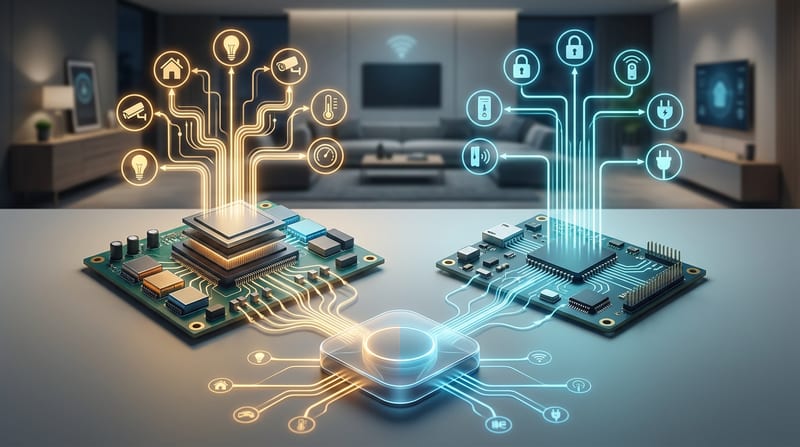
The decision between FPGA and microcontroller for a smart home hub comes down to workload profile, power budget, and long-term ownership cost. Market data shows microcontrollers dominate consumer IoT devices, growing at a 20.7% CAGR from 2025 to 2034, while consumer and smart-home segments represent less than 8% of total FPGA revenue. Evidence from actual teardowns confirms every major hub (Echo, Nest Hub, HomePod Mini, SmartThings) uses an ARM-based MCU or SoC rather than reconfigurable FPGA logic.
What's an FPGA? An FPGA refers to a field-programmable gate array - a chip containing arrays of reconfigurable logic blocks that can be programmed after manufacturing to implement custom digital circuits and parallel processing pipelines. Unlike microcontrollers, which execute sequential software instructions, FPGAs excel at truly parallel, deterministic signal processing but carry higher BOM cost, idle power, and development complexity.
| Factor | FPGA | Microcontroller (MCU) | Winner for Smart Home Hub |
|---|---|---|---|
| Silicon Cost (volume) | $10 - $40 | $1.50 - $6 | MCU |
| Idle Power | 75μW+ standby | 15 - 68μW light-sleep | MCU |
| Development Cost | $50K - $200K NRE (HDL) | $5K - $20K (firmware) | MCU |
| Interrupt Latency | Sub-microsecond possible | 72ns (Cortex-M4), ~3μs (ESP32 FreeRTOS) | MCU (sufficient) |
| Typical Hub Workload | Overkill | Ideal (I/O-bound packet routing) | MCU |
Do smart home hubs actually need FPGA parallel processing? No. A smart home hub spends 99.9% of its time idle, waking only to route small event-driven packets across Zigbee, Thread, WiFi, and BLE. This workload is I/O-bound rather than compute-bound. FreeRTOS runs on an estimated 40%+ of all embedded MCUs with an RTOS and supplies the necessary real-time behavior for these tasks (FreeRTOS Developer Documentation, 2025).
How much latency does a real smart home network actually experience? Zigbee 3.0 mesh hop latency runs 10-30ms per hop. A command crossing four hops produces 40-120ms total delay (IEEE 802.15.4 (Thread/Zigbee Physical Layer), 2025). Sub-microsecond FPGA response provides no practical benefit when the radio protocols themselves set the timing floor.
ARM Cortex-M4 Technical Reference Manual confirms the MCU architecture wins this workload. The ARM Cortex-M4 delivers interrupt latency of 12 clock cycles - 72 nanoseconds at 168 MHz (ARM Cortex-M4 Technical Reference Manual, 2024). ESP32 worst-case interrupt latency on FreeRTOS measures roughly 3μs. Both numbers exceed requirements for Matter, Thread, or Zigbee command routing.
BOM and power reality: ESP32-C3 versus Lattice iCE40 The ESP32-C3 uses a RISC-V core, costs $1.50 - $2.00, and includes WiFi and BLE. In contrast, comparable FPGA solutions cost 5 - 10× more on silicon and draw higher idle power. The ESP32-S3 BOM sits at $2.50 - $3.50 depending on flash and PSRAM configuration (Espressif ESP32-S3 Technical Reference Manual, 2025).
Does any smart home task actually require an FPGA? Modern MCUs have absorbed most remaining signal-processing workloads. A 512-point FFT completes in about 50μs on the ESP32-S3 vector unit versus <1μs on a Xilinx Zynq FPGA. Your hub doesn't run continuous FFTs or heavy digital signal processing - it moves packets and translates protocols (TinyML Foundation Benchmarks).
Security camera workloads expose the real difference When the hub also manages IP cameras, the distinction becomes clearer. A 4K (8MP) security camera at 30fps with H.265 encoding produces 8-12 Mbps - 40-50% less bandwidth than H.264 at the same resolution (HEVC/H.265 specification, 2024). Most of this processing happens on the camera’s own SoC, not the hub. Premium cameras use Ambarella CV-series processors (Ambarella CV2x/CV5x Series), while mid-range models rely on Sony IMX335 or IMX415 sensors (Sony Semiconductor - Security Camera Sensors, 2024).
One 4K/H.265 camera at 15fps continuous recording consumes ~2.7 TB per month. An 8-camera system requires 21.6 TB/month - far beyond what most residential NVRs ship with out of the box. Local storage remains far cheaper than cloud subscriptions that cost $480 - $780 over five years for four cameras.
The security and firmware reality most buyers miss Budget IP cameras typically ship with embedded Linux kernels from 2012 - 2019 and rarely receive updates after leaving the factory. Many rely on HiSilicon chipsets (now rebranded) that power roughly 35% of global IP cameras. The open-source OpenIPC project surpassed 400 supported camera models in Q4 2025, giving users an auditable alternative to factory firmware with supply-chain risks.
NIST’s Cyber Trust Mark and the EU Cyber Resilience Act now push manufacturers toward unique default passwords, regular security updates, and clear data disclosures. These requirements favor transparent MCU-based designs over opaque FPGA implementations in consumer products.
learn more choose your hub hardware in 2026
- Match the silicon to the actual workload - Use an MCU for protocol translation and command routing.
- Prioritize idle power and BOM cost - Target chips with <70μW light-sleep capability.
- Choose Matter-certified platforms - ESP32-C6, ESP32-H2, or Nordic nRF5340 for native Thread and Matter support (Connectivity Standards Alliance - Matter, 2025).
- For local camera recording, pair the hub with an NVR running ONVIF Profile T or G compliant devices (ONVIF Conformant Products, 2025).
- Implement local control - Run Home Assistant (1 million+ active installations) on Raspberry Pi or dedicated hardware for maximum privacy and zero recurring cloud fees (Home Assistant Statistics, 2024).
Action plan for implementation-heavy growth Start with an ESP32-C6 or ESP32-P4 based board for the hub. Add a Thread border router function (already present in many Apple and Google devices). For cameras, evaluate OpenIPC-compatible models to replace factory firmware. Block unnecessary manufacturer phone-home traffic at the firewall. This combination delivers low latency, strong privacy, predictable power consumption, and freedom from $10 - 13 monthly cloud subscriptions.
The market has already chosen. Microcontrollers deliver the right balance of capability, cost, and power for the workloads that actually exist in consumer smart homes and local security systems. FPGAs remain powerful tools for industrial, defense, and specialized high-speed signal processing - applications far removed from routing Zigbee packets and managing local IP camera streams.
Related decision criteria:
- Local vs cloud storage cost over 5 years
- Firmware update frequency and supply chain transparency
- Actual TOPS requirements for on-device AI features