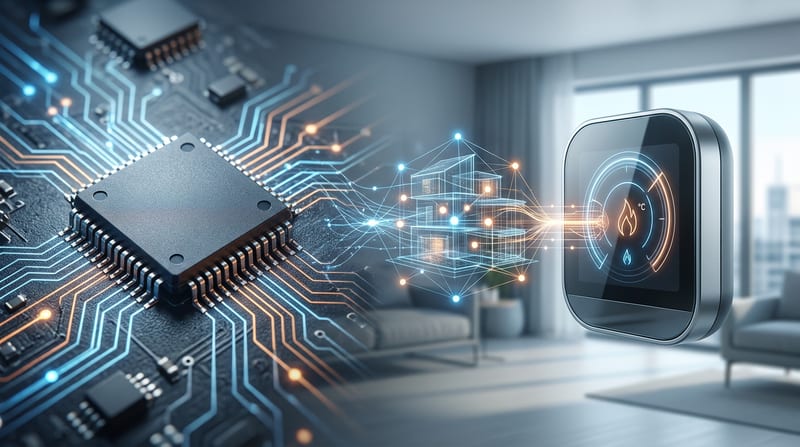
From Microcontrollers to Smart Thermostats: The Tech Inside Your HVAC
A smart thermostat runs a PID control loop on a $2 microcontroller. It samples a 12-bit temperature and humidity sensor every 10-30 seconds, calculates the error between target and actual conditions, and decides when to energize HVAC relays or modulate a variable-speed compressor. The display and Wi-Fi radio get the marketing attention. The PID loop running on an ARM Cortex-M4 or ESP32-class chip is what actually delivers the energy savings.
This article walks through the MCU selection for HVAC controllers, what the BOM actually looks like behind a $250 retail price, the installation reality that breaks 30-40% of deployments, and the gap between the ENERGY STAR 8% savings claim and what most homeowners actually see.
MCU Selection for HVAC Controllers
The thermostat workload is not compute-intensive. It is timing-sensitive. The PID loop must execute consistently every 10-30 seconds or temperature control oscillates. Wireless connectivity must stay active for occupancy detection. Relay timing must avoid contact bounce in humid wall cavities. Total active power must stay under 3 W because most thermostats draw from a 24 V AC common wire rather than dedicated mains.
ARM Cortex-M4 parts hit the sweet spot for this workload. The core runs at roughly 100 μW/MHz with hardware FPU and DSP instructions that accelerate the multiply-accumulate operations inside the PID math. STM32F4 series parts at 168 MHz with 1 MB flash land at $2-4 in volume. FreeRTOS ports from ST and third parties cover every peripheral. Worst-case interrupt latency sits around 3 μs and context switches run 2-5 μs. Both numbers sit comfortably inside the 10-30 second control loop budget.
ESP32-C6 takes a different tradeoff. It adds native Thread, Zigbee, and Wi-Fi 6 radios on-die in exchange for a slightly higher idle power than a pure Cortex-M4. For thermostats that need mesh connectivity without a separate radio module, it is the dominant choice. Light-sleep power sits at 15-68 μW depending on which peripherals stay armed for wake events.
Virtually zero commercial connected thermostats ship with FPGAs. The BOM math does not support it: MCU firmware runs $5K-20K NRE for a competent team, and FPGA designs push NRE to $50K-200K with per-unit silicon costs 5-10x higher. The control loop is not fast enough or parallel enough to justify reconfigurable logic.
The Real BOM Behind a $250 Smart Thermostat
A teardown reveals roughly $25-40 in actual components. The retail price covers cloud service amortization, channel margin, and design recovery.
| Component | Cost | Notes |
|---|---|---|
| ARM Cortex-M4 MCU | ~$2 | Main controller, PID loop |
| Wi-Fi/BLE SoC | ~$3 | Typically ESP32 variant or dedicated module |
| 12-bit temp/humidity sensor | ~$1.50 | Sensirion SHT31 or Bosch BME280 class |
| Display | $5-8 | LCD or e-paper |
| Relay board | ~$3 | 24V AC switching |
| Enclosure + passives | $8-20 | Plastic, battery, PCB |
| Total BOM | $25-40 | Retail sits at $90-$250 |
The relay board matters more than it looks. Contacts must close or open within 20 ms to avoid arcing, and humid wall cavities accelerate bounce to 5-15 ms. Debounce code on the MCU handles this but consumes cycles and adds latency. Skimping on relay quality shows up after 18-24 months as intermittent short-cycling that looks like a PID tuning problem but is actually a bounce problem.
The Installation Reality That Breaks 30-40% of Deployments
The C-wire is the single biggest failure mode for smart thermostats in older homes. A basic mechanical thermostat runs on battery power or parasitic draw from the heating signal line. A smart thermostat needs continuous 24 V AC to power the MCU, Wi-Fi radio, and display. That requires a dedicated common wire at the thermostat.
Roughly 30-40% of U.S. homes lack a C-wire at the thermostat location. The fix is either a C-wire retrofit (running a new conductor from the HVAC air handler to the thermostat, which costs $90-$140 in labor) or a power extender kit that steals power from the heating signal without adding a wire. Extender kits work but reduce available current headroom for the thermostat's radios, which causes WiFi dropouts during cold starts when the Wi-Fi radio demands peak current before the buck converter has stabilized.
Cost breakdown for a typical install:
| Line Item | Range | Notes |
|---|---|---|
| Thermostat hardware | $90-$250 | Ecobee, Nest, or compliant generic |
| Labor (standard swap) | $65-$200 | 1-2 hours |
| C-wire retrofit | $90-$140 | Affects ~35% of installs |
| Total typical | $184-$300 | National average $184-$200 |
Humidity-induced corrosion on relay contacts and antenna traces is the second biggest failure mode. Condensation inside the thermostat backplate destroys contacts within 18-24 months in humid climates (Gulf Coast, Pacific Northwest) unless the mounting plate has a proper gasket and the wall cavity behind it is sealed. This is invisible in the first year and shows up as intermittent failures starting in year two.
The ENERGY STAR 8% Claim vs Reality
ENERGY STAR-certified connected thermostats must demonstrate approximately 8% savings on heating and cooling energy through real-world field data from at least 5,000 connected units. The 8% number is better than typical lab-derived claims because it comes from actual deployed hardware.
The caveat that vendors rarely highlight: the 8-10% figure assumes replacement of a basic manual thermostat with no programmable schedule. Homeowners upgrading from an existing programmable thermostat typically see 2-3% additional savings from occupancy detection and learning algorithms. The marginal benefit is real but much smaller than the headline.
A September 2024 DOE/NREL study identified a large gap in the market: connected thermostat products target central ducted HVAC almost exclusively. Ductless mini-split heat pumps and room air conditioners lack standardized integration paths. Millions of apartments and older homes remain locked out of smart scheduling and demand-response programs because the hardware category does not exist for their HVAC architecture.
If your home already uses a programmable thermostat and follows a consistent schedule, expect 2-3% savings. The convenience and remote access are the real value. If you are upgrading from a manual thermostat with no schedule, the 8% figure is achievable.
Variable-Speed Compressors and the DSP That Drives Them
Variable-speed heat pumps and mini-splits use inverter-driven compressors. The compressor motor requires precise PWM generation from a motor-control MCU to modulate speed, and the control math sits in the DSP domain.
The motor controller runs a Field-Oriented Control (FOC) loop at 10-20 kHz. Phase currents feed back through shunt resistors or Hall sensors. A phase-locked loop synchronizes the drive waveform to motor position within 33-83 ms of startup. Poor PLL tuning injects current at wrong angles and cuts efficiency 2-5% at the CEC-weighted operating points. CEC weighting assigns 53% weight to the 75% load point and only 4% to the 10% load point. Compressors spend most of their life at partial load, so the weighting matters for annualized efficiency claims.
Space-vector PWM achieves 1-3% higher DC bus utilization than sinusoidal PWM and reduces harmonic distortion by 15-25%, but it demands 3-5x more DSP cycles per PWM period. Cortex-M4 and M7 parts with DSP extensions handle this workload. The thermostat itself talks to the compressor controller over a two-wire modulation protocol (proprietary to each manufacturer), not through the FOC loop directly.
This DSP complexity is why variable-speed heat pump controllers cost 3-4x a basic on/off compressor board, and why firmware quality varies more across brands than the mechanical specifications imply.
Protocol Translation and Matter 1.5 on Thermostats
Matter-certified device count passed 2,800 in early 2025 with adoption split across ecosystems. Matter 1.4 added thermostat control classes. Matter 1.5 improved occupancy signaling and added better integration with multi-admin hubs. A modern thermostat should support Matter over both Thread mesh and Wi-Fi, which pushes silicon selection toward MCUs with native Thread radios (ESP32-C6, Nordic nRF5340, Silicon Labs MG24).
The gap between what Matter enables and what vendors expose remains real. Apple, Google, and Amazon each implement Matter 1.4 with different feature coverage. SmartThings ships Matter 1.5 support. A thermostat certified Matter-over-Thread on paper may still require a vendor-specific app for schedule editing because the Matter thermostat cluster does not cover every feature a vendor wants to differentiate on.
What Actually Breaks in the Field
Wiring polarity and C-wire voltage. Many thermostats refuse to boot if C-wire voltage sags below 20 V AC. Measure at the backplate before mounting. If it reads 18-20 V, a power extender kit is a better call than the thermostat itself.
Humidity condensation on relay contacts. Seal the wall cavity behind the backplate with putty or foam. Gulf Coast installs without this step fail predictably in 18-24 months.
Wi-Fi drops during cold starts. If the thermostat rejoins the network 30-60 seconds after boot, the Wi-Fi radio is briefly starved for current during the radio init sequence. A C-wire retrofit fixes this. A larger bulk capacitor on an extender kit can also help.
30-day runtime monitoring. The 8% savings claim only materializes if the thermostat's occupancy detection and learning actually kick in. Compare pre-install runtime hours against post-install runtime hours for 30 days. If the numbers are flat, the occupancy sensor placement is probably wrong, or the home schedule is too consistent for learning to add value.
The Practical Buy Decision
A $2 ARM Cortex-M4 runs the PID loop that delivers most of the savings. A $3 ESP32 variant provides the radios. The rest of the retail price covers display, relay quality, enclosure engineering, app polish, and cloud service costs. Paying $250 for a connected thermostat is paying for firmware quality and a vendor that will still exist in five years, not for silicon.
If the home has a C-wire, the install is straightforward. If it does not, budget the extra $90-$140 for the retrofit upfront or plan for degraded Wi-Fi performance with an extender kit. Neither path is a dealbreaker. Skipping the decision entirely is.
Related: FPGA vs Microcontroller: Which Runs Your Smart Home Hub | Raspberry Pi Home Automation: A Practical Setup Guide