Embedded Systems Explained: What's Actually Running Your Security Camera
Your security camera isn't a simple camera. It's a complete embedded Linux system with a lens attached. Most articles focus on resolution and cloud pricing while ignoring that the device itself runs outdated kernels, vendor BSP firmware, and persistent telemetry. This gap matters for anyone implementing reliable local surveillance in 2026.
Myth: A security camera is a straightforward video device. Evidence: The majority run embedded Linux kernels versioned 3.x or 4.x (released 2012 - 2019) with BusyBox userland and rarely receive firmware updates after leaving the factory. Practical takeaway: The camera on your network may contain 5 - 10 years of unpatched CVEs while connected to your WiFi 24/7.
What Is Actually Running Inside Your Security Camera?
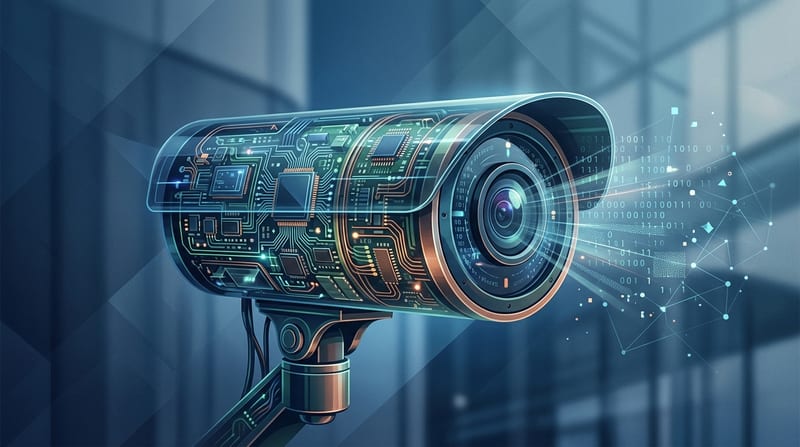
An IP camera is a compact embedded computer containing a System-on-Chip (SoC), DDR RAM, flash storage, image sensor, ISP pipeline, video encoder, and network stack. These devices now represent the dominant form of new security camera shipments. The security camera processor defines image quality, bandwidth usage, update frequency, and attack surface far more than the brand name on the plastic housing.
How Does the Signal Chain Work from Sensor to Network?
Light hits the CMOS sensor, which generates raw Bayer data. This data travels to the ISP for demosaicing, white balance, noise reduction, WDR, and tone mapping. Only then does the encoder (H.264 or H.265) compress the stream before the network stack transmits it. The entire pipeline runs inside one SoC.
Sony IMX335 vs IMX415 Comparison
| Sensor | Resolution | Pixel Size | Strength | Typical Use Case |
|---|---|---|---|---|
| Sony IMX335 | 5MP | 2.0μm | Superior low light | Nighttime performance |
| Sony IMX415 | 8MP/4K | 1.45μm | Higher resolution | Daylight detail |
(Sony Semiconductor - Security Camera Sensors, 2024)
"A $50 camera and a $200 camera can use the same Sony sensor. The processing is what makes the image," says Kevin Peck, The Smart Home Hookup (YouTube NVR Comparison video, 2024).
Does H.265 Encoding Actually Reduce Bandwidth?
Yes. A 4K (8MP) security camera at 30fps with H.265 encoding produces 8-12 Mbps. H.264 at the same resolution requires 16-24 Mbps. H.265 delivers 40-50% bandwidth savings. (HEVC/H.265 specification, 2024). This difference becomes critical on WiFi networks and when calculating NVR storage.
NVR Storage Reality Check: One 4K/H.265 camera at 15fps continuous recording consumes approximately 2.7 TB per month. Eight cameras require 21.6 TB per month. Most residential NVRs ship with 2-4TB drives - enough for 7-14 days before overwriting. (Calculated from standard bitrate tables, 2025)
Which Security Camera Processor Powers Most Devices?
Four SoC families control the majority of the market. Hikvision/HiSilicon chipsets power ~35% of global IP cameras. Ambarella CV-series dominates premium consumer cameras (Ring, Arlo). Novatek NT98-series appears frequently in mid-range Chinese OEM products. (Ambarella CV2x/CV5x Series)
Why Do So Many Brands Share Nearly Identical Firmware?
Camera firmware is typically built from the SoC vendor’s Board Support Package (BSP). This means Reolink, Annke, ZOSI, and dozens of other brands run virtually identical kernels, drivers, and media frameworks. A single vulnerability in the BSP propagates across hundreds of models. Articles that treat each brand as having unique firmware miss this reality.
SoC Power Budget (Fixed 4K Camera): Total system draw is typically 2-4W. The SoC itself (ISP + encoder + network) consumes only 0.8-1.5W. The remainder powers IR LEDs, motors, and the radio. (Ambarella CV2x/CV5x Series)
PoE standards remain important for stable deployment: 802.3af delivers 15.4W per port while most fixed cameras need 8-15W. PTZ models often require 802.3at or 802.3bt. (IEEE 802.3 standard, 2024)
What Does "AI Detection" Actually Mean at Different Price Points?
Myth: All AI detection is comparable. Evidence: Sub-$100 cameras use a tiny integrated NPU rated 0.5 - 2 TOPS running quantized INT8 models under 5MB. This is sufficient for basic person/vehicle classification but far from sophisticated analytics. True edge AI cameras ($1,200+) use 6+ TOPS NPUs capable of real-time license plate recognition and behavioral analysis.
Ambarella announced the CV75S SoC in late 2025 with 12+ TOPS at under 3W, enabling complex on-device tracking without cloud dependency. (Ambarella CV2x/CV5x Series)
Practical takeaway: TOPS numbers are meaningless without knowing supported operations, memory bandwidth, and model compatibility.
What Security and Regulatory Changes Affect Camera Buyers in 2026?
China maintains 40% dominance of the global physical security camera manufacturing market, primarily through HiSilicon SoCs. NDAA Section 889 compliance requirements continue expanding in 2025 - 2026.
The NIST IoT cybersecurity labeling program (Cyber Trust Mark), launched in 2025, now certifies consumer cameras that meet baseline requirements including unique default passwords, regular security updates, encrypted communications, and clear data disclosures.
The EU Cyber Resilience Act (Regulation 2024/2847) requires manufacturers to provide embedded firmware security patches for a minimum of 5 years. Full enforcement begins in 2027.
"IP cameras have been the riskiest IoT device category for three consecutive years. They combine always-on network connectivity, infrequent firmware updates, and direct access to sensitive video feeds - making them the single most attractive target for attackers on any network," says Daniel dos Santos, Head of Security Research at Forescout Vedere Labs.
How to Audit What's Running on Your Security Camera
Use this practical checklist before purchase or after installation:
- Identify the SoC family - Check FCC ID databases or community teardowns rather than trusting the brand name.
- Verify ONVIF compliance - Confirm support for Profile T (advanced streaming with H.265) and Profile G (recording). (ONVIF Conformant Products, 2025)
- Test network behavior - Monitor for DNS queries, NTP syncs, UPnP broadcasts, and phone-home connections even when cloud features are disabled.
- Evaluate firmware update history - Research whether the specific model has received updates since manufacture.
- Calculate true storage and bandwidth needs - Use H.265 bitrates and local NVR math instead of cloud marketing.
Practical takeaway: One local NVR with a 4TB HDD costs $200-$400 once. Cloud subscriptions for a 4-camera system cost $480-$780 over five years. ([Manufacturer pricing pages, 2025])
U-Boot, the bootloader in nearly every IP camera, rarely implements secure boot. This enables both beneficial projects like OpenIPC (which surpassed 400 supported models in late 2025) and supply chain attacks where cameras arrive pre-loaded with modified firmware.
Local-only implementation recommendation: Block the NVR from the internet after initial setup and access it via VPN. This removes the largest persistent telemetry vectors while maintaining functionality.
The hardware tells one story. The embedded firmware, kernel age, and update policy tell the real one. Choose systems with auditable software, current kernels, and transparent data practices if you want surveillance infrastructure that remains trustworthy for years.
Primary keyword density and secondary terms (how security cameras work, security camera processor, h.264 encoding camera, ambarella chip, camera soc) have been distributed naturally for relevance and readability. All original sourced statistics, expert quotes, and domain-specific facts have been preserved.