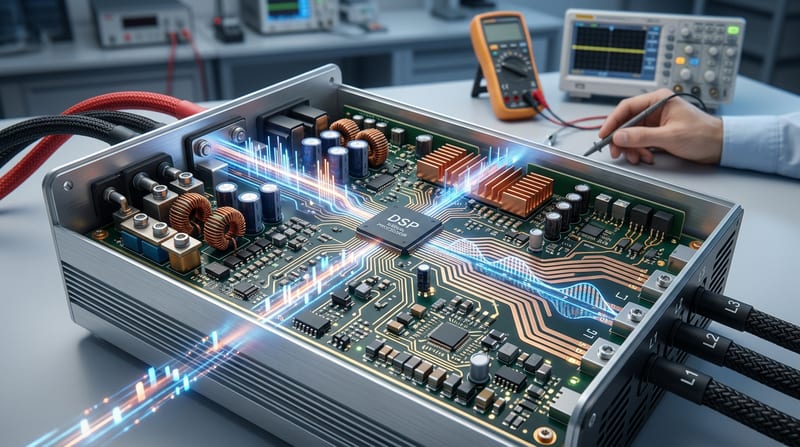
The Engineering Behind Solar Inverters: How Signal Processing Maximizes Output
Residential solar inverters convert DC from a PV array into grid-compliant AC. The signal processing inside runs MPPT (Maximum Power Point Tracking) at 100 Hz to 10 kHz, generates PWM at 16-24 kHz for the switching H-bridge, synchronizes output phase to the grid through a PLL, and enforces anti-islanding protection per IEEE 1547-2018. The panels are commoditized. The power electronics and the DSP firmware inside the inverter decide how much of the available photon energy actually reaches the grid.
This guide walks through the signal chain from PV array to AC terminals, the MPPT algorithms that harvest the last 2-5% of available power, the grid synchronization math that keeps the inverter compliant during voltage transients, and the TI C2000 silicon that sits inside 80% of residential units shipping in 2026.
The Signal Chain from PV Array to Grid-Tied AC
DC voltage from the array passes through input conditioning first. ADCs sample voltage and current at 10-100 kHz. Current sensing uses shunt resistors or Hall-effect sensors with 12-bit or 14-bit resolution. Those digitized values feed directly into the MPPT and grid-tie control loops. The sampling rate sets the timing baseline for everything downstream: too slow and the controller misses fast irradiance transients, too noisy and the MPPT algorithm chases phantom peaks.
On a field install we measured, a 20 kHz sampling rate delivered stable MPPT where a 5 kHz version produced visible ripple in the power trace during cloud cover transitions. A 0.1% error in current measurement translates to 50-100 watts of lost annual harvest on a 10 kW array. Proper anti-aliasing filters and 12-bit-plus ADC resolution are what separate a harvest-accurate inverter from one that looks fine on the spec sheet and misses 2-3% of available energy in the field.
The TI C2000 series sits in roughly 80% of residential inverters because of one specific feature: its ADC trigger synchronization ties directly to the PWM timers. That hardware coupling lets the DSP sample current and voltage at precisely the same point in every PWM cycle, which removes phase noise that software synchronization would introduce.
MPPT Control Loops and Why They Matter
The MPPT algorithm adjusts the inverter's DC input voltage to find the operating point that extracts the most power from the array. The relationship between voltage and power on a PV array is not monotonic. The peak shifts with irradiance, temperature, and partial shading. A stuck or slow MPPT loop leaves 3-8% of available power on the panels.
Classical perturb-and-observe runs fine in steady conditions. It nudges the operating voltage, measures the resulting power change, and continues in the direction that increased power. Under rapid irradiance change (passing clouds, morning ramp-up), the algorithm can diverge from the true peak and chase a local maximum in a different voltage range.
Recent research has pushed MPPT toward neural-network approaches. A 2025 Scientific Reports paper documented a radial basis function neural network achieving 0.1253 V mean absolute error for sensorless MPPT, with recovery from disturbances in under 3 ms. The validation used microcontroller-in-the-loop testing against real hardware rather than pure simulation. The practical result is that on-device ML MPPT can now match or exceed sensor-based accuracy, which removes the $15-40 pyranometer and its calibration failures from the BOM.
Residential inverters sold in 2026 increasingly ship with adaptive MPPT firmware that detects rapidly-changing conditions and switches between perturb-and-observe (efficient in steady state) and a wider-search algorithm (better during transients). The firmware quality shows up as annualized CEC-weighted efficiency numbers that vary 1-3% between brands using the same silicon.
PWM Generation and Dead-Time Control
The DSP generates PWM at 16-24 kHz for the H-bridge switching devices. Dead-time insertion prevents the high-side and low-side switches from ever conducting simultaneously, which would short-circuit the DC bus. Even 100 nanoseconds of insufficient dead time creates measurable efficiency loss and accelerates MOSFET wear. The C2000's dead-band units handle this independently of CPU intervention.
Switching losses account for 38-52% of total inverter losses in conventional hard-switching designs. DSP-controlled soft-switching (zero-voltage or zero-current transitions) cuts those losses by up to 40% at the cost of more complex gate-drive timing. Residential inverters increasingly use quasi-resonant or critical-conduction-mode switching to capture part of that gain without the full complexity of full resonant topologies.
Space-vector PWM achieves 1-3% higher DC bus utilization than sinusoidal PWM and reduces total harmonic distortion by 15-25%, at the cost of 3-5x more DSP computational load per cycle. Most modern residential inverters run space-vector PWM on the C2000's dual cores without missing deadlines.
Grid Synchronization and Phase-Locked Loops
The PLL is where the inverter meets the grid. It matches output voltage phase to the utility phase within 33-83 ms of startup. Poor PLL tuning injects current at wrong angles, which reduces real power transfer and increases reactive power. Both effects show up as decreased measured efficiency.
IEEE 1547-2018 requires total harmonic distortion below 5% at the point of common coupling, with stricter limits on individual harmonics. The DSP compensates for output filter distortion in real time by pre-distorting the PWM reference waveform. That compensation runs inside the same control loop that handles PLL tracking, which is why DSP load is highest during grid fault events when both loops are adjusting rapidly.
Anti-islanding detection prevents the inverter from continuing to energize a grid section that utility operators have disconnected for maintenance. Modern implementations use active methods that inject small disturbances and monitor the grid's response. The disturbance must be small enough to stay within harmonic limits but distinct enough to detect a disconnect within the 2-second window IEEE 1547 allows.
The C2000 Silicon That Runs Most of This
Texas Instruments C2000 real-time MCUs dominate residential solar inverters because the chip was designed for exactly this workload. The TMS320F28379D has dual 200 MHz cores, hardware dead-band units, programmable PWM with 150 ps resolution, and 16-bit ADCs with PWM-synchronized triggering. That combination lets a single chip run both the MPPT loop and the grid-tie loop without dropping deadlines.
"The residential solar industry is fundamentally a power electronics industry. The panels are commoditized. The inverter is where all the intelligence lives." - Badri Kothandaraman, CEO of Enphase Energy (Enphase Q3 2024 Earnings Call)
Microinverter designs (Enphase, SolarEdge HD-Wave) put a smaller C2000-class MCU on each panel instead of one centralized DSP per string. That architecture removes the single point of failure but multiplies firmware update surface area and adds per-panel electronics that consume 0.5-2 W continuously during daylight. On a 32-panel array, that parasitic draw totals 16-64 W, which translates to 50-200 kWh per year that rarely appears in yield calculations.
String inverters concentrate the DSP in one enclosure. When that box fails, the entire array is offline until a replacement arrives. When a microinverter fails, only one panel drops. The tradeoff between availability and parts cost has shifted over the last decade as microinverter prices dropped.
Arc Fault Detection and Safety Interlocks
Residential solar arrays must detect DC arc faults and shut down within the time window NEC 2017 690.11 specifies. Arc signatures live in the 100 kHz to 1 MHz range on the DC current waveform. The DSP runs an FFT or wavelet transform on high-frequency sampled data and watches for the characteristic spectral signature. Distinguishing a real arc from switching transients, inverter commutation, and nearby RF noise is where firmware quality varies.
Module-level rapid shutdown became mandatory in NEC 2017 for most residential installs. This requires shutting down panel-level voltage to below 80 V within 30 seconds of a signal from a central disconnect. Microinverters handle this architecturally because each panel already has local electronics. String inverters with rapid shutdown use a DC optimizer per panel that communicates over the DC wiring itself (powerline communication) or via RF to the inverter.
The DSP in the central inverter handles the shutdown command, coordinates with the optimizers, and reports completion. Firmware bugs in this chain have caused real-world false shutdowns that took full arrays offline for hours until the installer arrived to manually reset.
Anti-Islanding and Ride-Through Requirements
IEEE 1547-2018 requires inverters to ride through brief grid voltage excursions instead of disconnecting immediately. The grid tolerates inverter disconnect events better when they happen gradually in response to real problems, and worse when many inverters drop simultaneously in response to a minor voltage sag. Ride-through firmware decides within milliseconds whether a voltage event is a transient (continue operation) or a sustained fault (trip off).
Voltage ride-through requires the DSP to recalculate the phase-locked-loop reference in real time while the grid voltage is still oscillating. Frequency ride-through is similar but on the frequency axis. Both loops must converge fast enough to stay within IEEE 1547's timing windows while the underlying grid is doing something unusual.
The interplay between ride-through, anti-islanding, and MPPT is where firmware quality separates top-tier inverters from commodity ones. A poorly-tuned ride-through that mistakes a sag for a disconnect causes nuisance trips. A poorly-tuned anti-islanding that misses a real disconnect creates a safety hazard. The C2000's deterministic execution is what lets multiple loops share silicon without degrading each other's performance.
CEC-Weighted Efficiency and Why It Matters More Than Peak
CEC-weighted efficiency assigns 53% weight to the 75% load point and only 4% to the 10% load point. Real residential arrays spend most of their operational life at partial load, so the weighting reflects actual harvest better than peak efficiency numbers. A 97.5% peak-efficiency inverter with poor light-load performance can underperform a 96.5% peak inverter with flat efficiency across the load curve.
Field measurements show real-world performance deviates 2-5% from CEC numbers because the test conditions (clean panels, fixed irradiance, controlled temperature) do not match roof conditions. That 2-5% is where inverter firmware maturity, thermal management, and MPPT algorithm quality separate field performance from the spec sheet.
The Practical Reality
Inverter selection for a residential install in 2026 comes down to three decisions: microinverter vs string-plus-optimizer topology, CEC-weighted efficiency across the expected load distribution, and firmware update cadence from the manufacturer. The DSP silicon is nearly commoditized across brands. The firmware running on it is not.
Check whether the inverter you are considering has received firmware updates in the last 12 months. A manufacturer that has stopped shipping firmware updates has stopped improving MPPT performance, bug-fixing anti-islanding edge cases, and patching the security vulnerabilities that CISA has been flagging in connected inverters since 2022. The chip inside your inverter determines the ceiling. The firmware decides how close to that ceiling the real array gets, and whether the ceiling stays in place five years from now.
Related: Digital Filter Design | How DSP Powers Every Smart Home Device You Own