What Is a Digital Signal Processor (and What It Is Not)
First, let's kill an acronym problem before it starts. In electronics, DSP means digital signal processor, the chip, or digital signal processing, the discipline. The same three letters get used in advertising for "demand-side platform," which has nothing to do with any of this. We're talking about the electronics version. If someone at a conference says "DSP" and you're confused, ask which one they mean.
A Digital Signal Processor is a specialized microprocessor architecture optimized for mathematical operations on digital signals like audio, RF, and sensor data. According to Texas Instruments TMS320 Family Overview, the defining trait versus a general-purpose CPU is single-cycle multiply-accumulate, or MAC, throughput. One multiply-accumulate per clock tick. A conventional CPU can't match that without burning far more power.
According to UT Austin Prof. Brian Evans EE445S DSP course notes, the Harvard architecture with separate instruction and data memory buses is the foundation of this performance. Classical von Neumann designs can't fetch an instruction and a data sample simultaneously. The DSP can, and that's the whole game.
Real hardware examples hit the range of where DSPs live today. According to Qualcomm developer docs, the Hexagon DSP in Snapdragon SoCs handles always-on sensors and offloads ML inference across process nodes from 28nm down to 7nm. According to TI C2000 Product Line, TI's C2000 family dominates residential solar inverter MPPT control with over an estimated 80 percent market share. The analog side has heavy hitters like Analog Devices' ADSP-21489. According to the ADSP-21489 datasheet, it delivers 2,700 MFLOPS at 450 MHz with dedicated hardware accelerators.
If I'm being honest, most people overcomplicate what a DSP actually does. As Steven W. Smith put it, you need the convolution integral, the Fourier transform, and one hour with a tap-delay FIR and a signal generator. Everything else is notation.
Now let's get specific about what matters on a spec sheet.
The DSP Chip Spec Sheet: What the Numbers Actually Mean
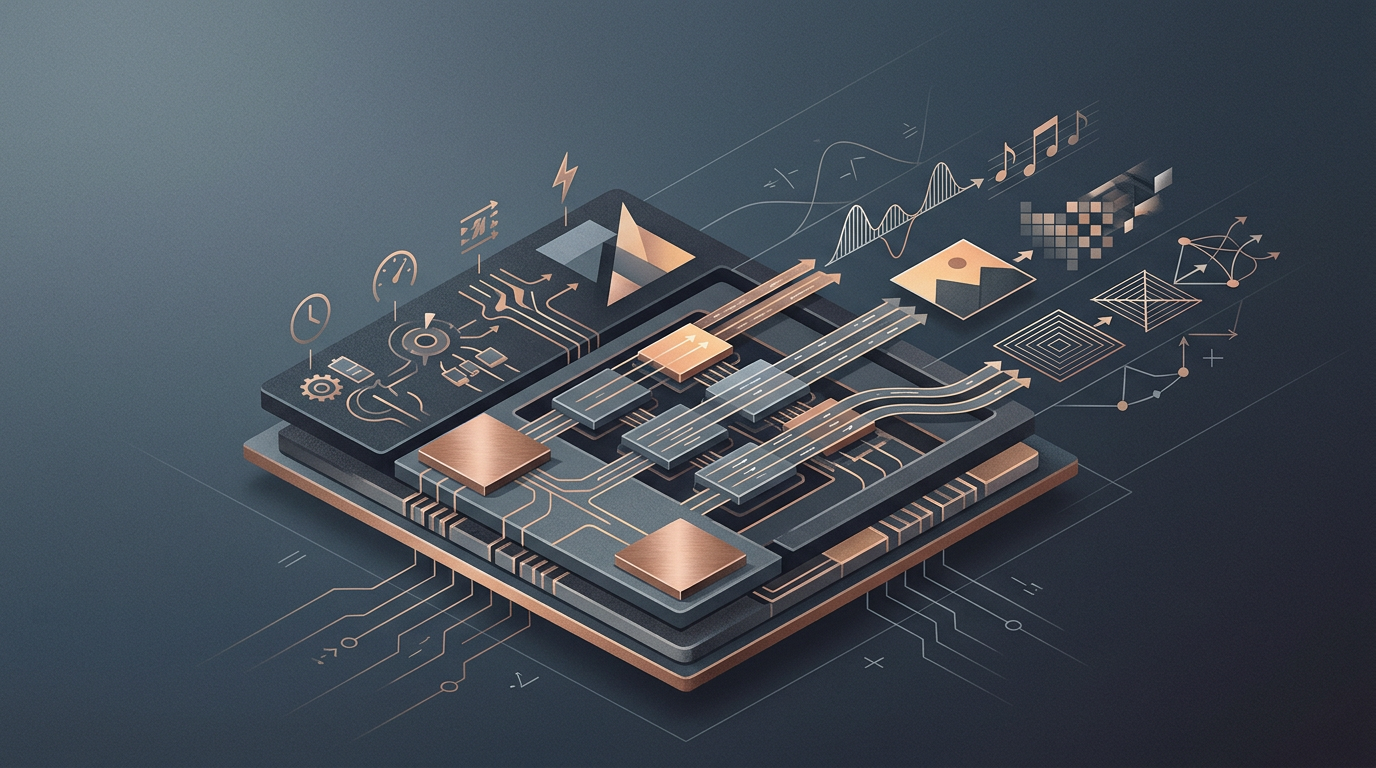
Marketing loves to slap peak MIPS or MACs per second in bold on a DSP chip spec sheet. Yet that headline number rarely predicts how your algorithm will actually behave. It's like judging a truck solely by its top speed while ignoring what it can haul. Real performance lives in the sustained throughput your specific workload can maintain.
Dig into the memory architecture next. How much fast on-chip SRAM sits there? Is it split between program and data, or unified? And how wide is the bus to external memory? A blazing clock speed means nothing if the chip constantly stalls waiting on data from sluggish off-chip RAM. That's why only benchmarks that mirror your actual application, an FIR filter, an FFT, whatever you run, deserve head-to-head comparison between vendors. "The Scientist and Engineer's Guide to Digital Signal Processing" nails it: moving data in and out of the processor remains a primary choke point.
Fixed-point or floating-point? The spec sheet states the native data width plainly, usually 16-bit fixed, 32-bit float. The decision hinges on dynamic range requirements and your power budget, not abstract superiority. Floating-point delivers easier code and generous headroom. It also consumes more power and silicon. In high-volume embedded designs, fixed-point frequently wins on pure cost, and this single trade-off can reshape the entire bill of materials.
The "ease-of-use" claims on most spec sheets feel like pure fantasy. "Easy to program" usually translates to "we ship decent libraries." That's not an architecture that forgives mistakes.
Forget the glossy "typical" power figure too. Hunt instead for active core power at your exact clock speed and voltage. That's the number that sizes your heatsink and supply. Every signal chain you eventually build rests on these foundational choices. Next we'll follow that signal from the analog world into the digital domain.
How the Signal Chain Works: From ADC to Filtered Output
Your analog signal has finally been amplified and conditioned. Now it slams into the analog-to-digital converter. This is the moment the physical world's voltage turns into a stream of numbers. The ADC samples that voltage at precise instants and assigns each snapshot a digital value, like a camera freezing a changing scene.
You can't simply shove a raw signal straight in, though. An anti-aliasing filter must come first. This analog low-pass filter, as Analog Devices explains, strips away high-frequency noise and interference before the ADC ever sees it. Without that protection, those frequencies fold back into the digital output as false lower-frequency signals, the classic aliasing problem. The same filter also shields the ADC's input from dangerous overvoltage spikes.
Once converted, the signal is digital but far from pristine. Digital filtering takes over here. Filters applied after sampling scrub away noise picked up during conversion itself, power supply ripple, reference instability, and the ADC's inherent quantization noise. Oversampling proves especially elegant: by sampling far faster than the Nyquist rate, it spreads quantization noise across a much wider band. A sharp digital filter then limits the band, decimates to the final sample rate, and delivers a noticeably better signal-to-noise ratio.
That same trick also eases the demands on your analog anti-aliasing filter's roll-off. It's a real relief. You don't need as steep a transition band when the oversampling ratio is doing some of the heavy lifting for you.
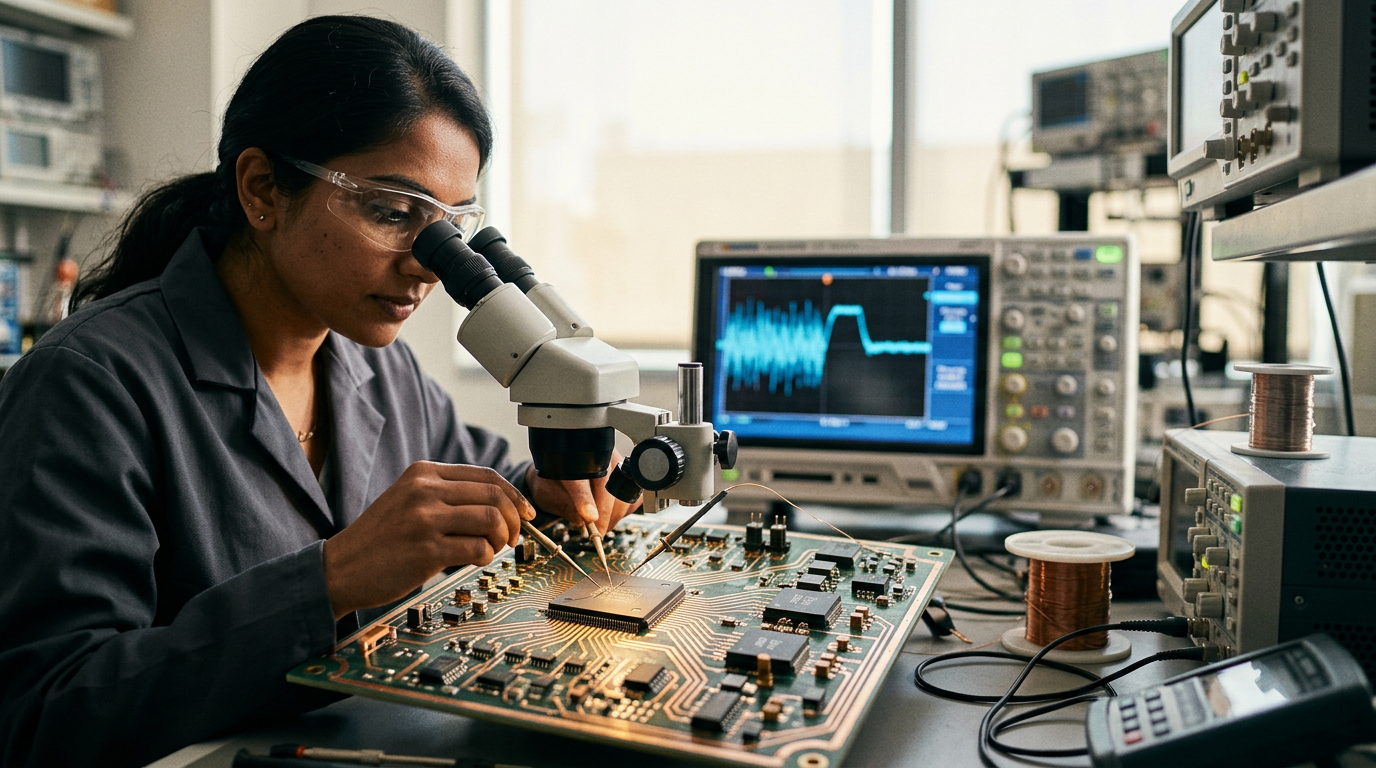
Of course, none of this is free. It demands serious processing power and higher-spec ADC silicon. I still tear apart dead boards just to see how different manufacturers actually stitch this chain together. Theory looks flawless on paper. Real implementations reveal the messy compromises between cost and performance.
Grasping the full chain puts you in a much better position to understand where all that clean data ultimately goes. We'll visit those common destinations next.
Where DSP Chips Actually Run: Audio, Radar, and Voice Assistants
Those destinations fall into a few heavy-use categories. They're the applications demanding raw, deterministic math, and they often land in the same silicon.
Radar processing is a prime example. According to Intel Stratix 10 DSP Architecture, their Stratix-10 FPGAs include dedicated DSP blocks that handle a 27x27 multiply and a 48-bit accumulate in one cycle. That's the kind of throughput you need for 5G baseband processing or real-time radar signal analysis where latency isn't negotiable. It's also why you'll find them handling order matching in high-frequency trading.
Voice assistants run on a different kind of efficiency. The always-on wake-word detection in your phone or smart speaker uses a specialized low-power core. According to Qualcomm Hexagon DSP SDK, their Hexagon DSP inside Snapdragon SoCs performs this task at under 1 mW. That's the entire reason "OK Google" or "Hey Siri" can listen constantly without draining your battery. It's a dedicated, always-on math engine focused on pattern matching.
Professional audio processing has its own standard. According to Analog Devices SHARC+ product page, their SHARC+ family (the ADSP-214xx and ADSP-215xx series) is the go-to for professional audio gear. It's the processing muscle inside high end noise cancellation like Bose QC systems, dbx equalizers, and Waves software plugins. The chip handles complex filtering and dynamics algorithms with the precision the audio world demands.
This is still a simplification. Each of these chips is a platform. The real magic is in the firmware and algorithms tuned for that specific silicon, which we'll break down next as we compare the fundamental architectural choices.
DSP Chip vs. MCU vs. FPGA: Picking the Right Silicon for the Job
The firmware and algorithms we just discussed don't run on air. They get compiled for, and accelerated by, the underlying silicon. Pick the wrong one and you're stuck with ugly trade-offs in power and speed. Development time takes a hit too.
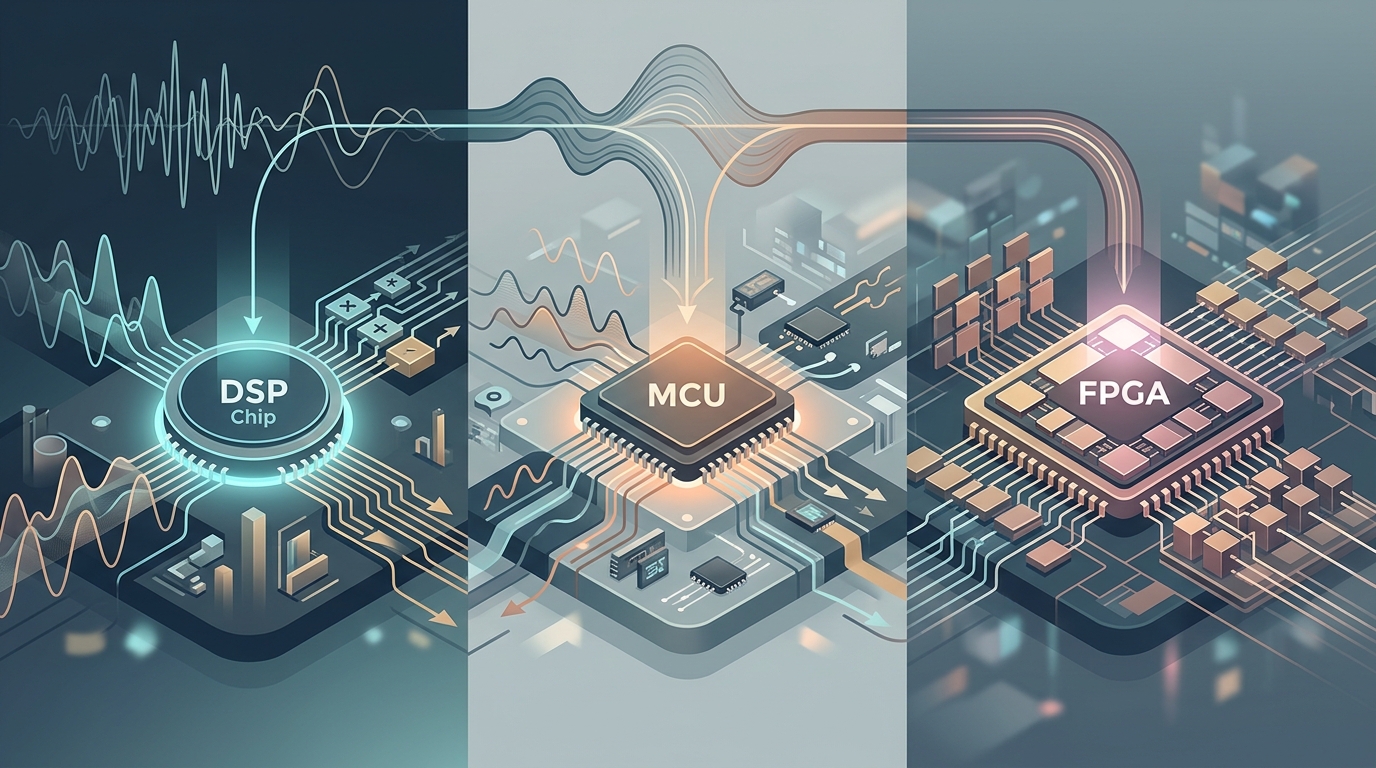
A microcontroller shines at control logic and simple I/O. Cheap, familiar toolchain, straightforward. Hit it with real-time video analytics, though, and it slams into a wall. A dedicated DSP chip, by contrast, is built from the ground up for vector math. It tears through FFTs and FIR filters with an efficiency a general-purpose CPU can only dream of.
Flexibility becomes the catch. Change the algorithm and you may need fresh hardware. That's exactly where an FPGA earns its keep. Picture a blank canvas of programmable logic: you design custom data pipelines, parallelize operations all the way down to the individual bit. The price? Steep development complexity and higher power draw.
Modern hybrid devices are quietly erasing those old boundaries. The AMD Versal ACAP, for example, packs a scalar CPU core, FPGA fabric, and dedicated AI Engine tiles onto a single die. Each AI Engine is a 7-way VLIW DSP core optimized for high-throughput math such as machine learning inference. Suddenly you can partition cleanly, the MCU runs the OS, the FPGA tackles custom preprocessing, and the DSP array crunches the model.
If I'm honest, the toolchain for these mixed architectures can still be a nightmare to set up. Yet for the right workload the performance per watt is unbeatable.
We'll get into the specific ways these components fail next. Because picking the right chip is only half the battle. That's just the start.
DSP Failure Modes: What Goes Wrong and How to Catch It Early
What actually fails on a DSP once it's out in the field? Spotting the usual culprits early lets you bake smart checks into your bringup routine. That alone can save a truck roll or two.
Start by watching thermals hard during stress testing. Poor cooling triggers throttling. Eventually, it pushes silicon past the point of no return, not a gradual decline, but a cliff that hits all at once when thermals spiral out of control and the chip has nowhere left to go. Next, put your power rails under real load. A noisy or unstable supply invites random resets and corrupted memory.
If your chip has ECC, run those memory error checks too. Then confirm the clock source stays stable and dead accurate, because a drifting oscillator quietly wrecks your signal processing.
And always flash the latest validated firmware. Configuration slip-ups and software bugs still top the list of phantom headaches.
The next section tackles the questions we hear most. It's a quick read.
Frequently Asked Questions
Is a DSP the same thing as a microcontroller? No. A microcontroller is built for control logic and I/O; a DSP is built for streaming math. The architectural tell is the MAC unit: a DSP executes a multiply-accumulate every clock cycle, sustained, with Harvard-architecture buses feeding it an instruction and a data word simultaneously. Plenty of modern MCUs bolt on DSP extensions, but sustained filter throughput per watt still belongs to the dedicated architecture.
Should I pick fixed-point or floating-point? Follow the dynamic range and the power budget, not the spec-sheet prestige. Floating-point gives you headroom and simpler code, at a cost in power and silicon. High-volume embedded designs usually land on fixed-point because unit cost wins. If your algorithm has wide dynamic range, like audio mastering or radar, floating-point earns its premium.
Why do vendors quote MIPS numbers that seem inflated? Some are. TI's C6000-family "RISC MIPS" figure multiplies clock rate by 8 because the VLIW core can issue eight instructions per cycle. The number that predicts filter performance is MMACS, million multiply-accumulates per second. When you compare chips, compare MMACS running your actual workload, not the marketing MIPS.
How does my phone listen for a wake word without killing the battery? A dedicated low-power DSP core does the always-on listening. Qualcomm's Hexagon runs wake-word detection at under 1 mW, per their developer documentation, while the main CPU sleeps. The big cores only wake up after the DSP hears the trigger phrase.
What actually kills DSP chips in the field? Heat, dirty power, and drifting clocks, in that order of frequency in my teardowns. Thermal failure is a cliff, not a slope. A noisy supply rail causes resets and memory corruption that look like firmware bugs. And a drifting oscillator silently degrades every filter and FFT the chip computes before anyone notices.