# Best Home Security Camera 2026: What the Specs Actually Mean
The best home security camera in 2026 delivers reliable local video processing, auditable firmware, and minimal cloud dependency while surviving real-world supply chain, regulatory, and cyber risks. Most spec sheets obscure the engineering tradeoffs that separate a durable asset from an expensive attack surface.
IP cameras now represent 70% of all security camera shipments globally. Each unit contains a full embedded Linux system rather than simple analog circuitry. This shift creates new capabilities but also turns every camera into a persistent network endpoint with its own attack surface.
Why Most "Smart" Cameras Remain High-Risk IoT Devices
IP cameras have been the riskiest IoT device category for three consecutive years. They combine always-on network connectivity, infrequent firmware updates, and direct access to sensitive video feeds - making them the single most attractive target for attackers on any network, says Daniel dos Santos, Head of Security Research at Forescout Vedere Labs.
Concrete takeaway: Assume any camera without a documented 5-year firmware commitment will become an unpatchable liability within 24 months. Prioritize vendors publishing clear update timelines before purchase.
Myth: Higher Megapixels and Sensor Names Guarantee Better Image Quality
Evidence first: Sony dominates the mid-to-high-end IP camera market with the IMX335 (5MP, 2.0μm pixel size) and IMX415 (8MP/4K, 1.45μm pixel size). Larger pixels improve low-light performance while smaller pixels favor resolution. However, two cameras using the identical Sony sensor can produce dramatically different results depending on the ISP pipeline (Sony Semiconductor - Security Camera Sensors, 2024).
A $50 camera and a $200 camera can use the same Sony sensor - the processing is what makes the image, says Kevin Peck, The Smart Home Hookup.
Concrete takeaway: Always verify the full signal chain (sensor + ISP + SoC) rather than sensor model alone. Request ISP pipeline documentation or sample footage under controlled low-light conditions during evaluation.
How H.265 and Proper Codec Support Impact Bandwidth and Storage
A 4K (8MP) security camera at 30fps with H.265 encoding produces 8-12 Mbps. H.264 at the same resolution requires 16-24 Mbps. H.265 saves 40-50% bandwidth (HEVC/H.265 specification, 2024).
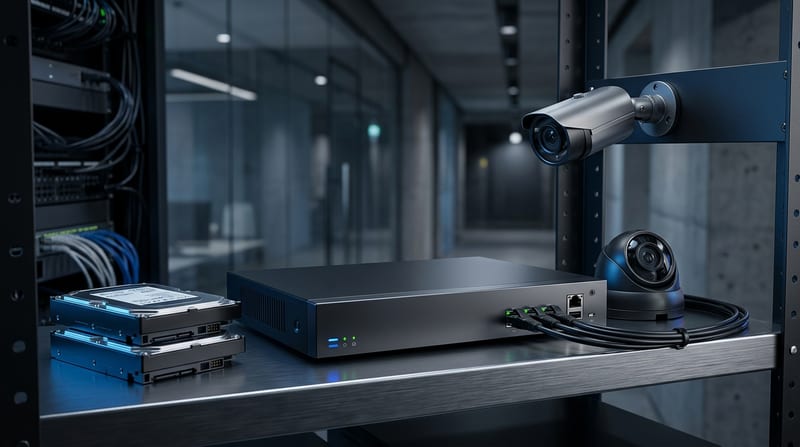
One 4K/H.265 camera at 15fps continuous recording consumes roughly 2.7 TB per month. Eight cameras generate 21.6 TB per month. Most residential NVRs ship with 2-4TB drives - enough for only 7-14 days of continuous 8-camera recording before overwrite.
ONVIF Profile S is supported by 90%+ of IP cameras. Profile T (advanced streaming with H.265) adoption sits at ~60%. Profile G (recording/storage) reaches ~40%. Full ONVIF compliance determines true NVR interoperability (ONVIF Conformant Products, 2025).
Concrete takeaway: Calculate your actual storage needs using H.265 bitrates before selecting an NVR. Plan for local storage expansion rather than assuming factory drives will suffice beyond two weeks.
How AI Detection Claims Hide Serious Limitations in Edge Processing
Evidence first: Most sub-$100 cameras use 0.5 - 2 TOPS NPUs running tiny quantized models under 5MB. These handle basic person/vehicle detection but fail at behavioral analytics or multi-object tracking under load. Premium systems using Ambarella’s CV75S SoC (announced late 2025) deliver 12+ TOPS at under 3W, enabling real-time analytics without cloud dependency (Ambarella CV2x/CV5x Series).
TOPS numbers remain meaningless without knowing supported operations (INT8 vs FP16), memory bandwidth, and actual model compatibility.
Concrete takeaway: Test AI features with your specific use case (nighttime, rain, complex scenes) before deployment. Assume cloud fallback will be required for any camera under $400 unless the manufacturer publishes verifiable on-device model benchmarks.
Why the SoC Chipset Determines Your Long-Term Attack Surface
HiSilicon chipsets power ~35% of global IP cameras. Hundreds of brands share identical board support packages and kernel code. A single vulnerability in the shared firmware impacts dozens of models simultaneously.
China maintains approximately 40% dominance of the global physical security camera manufacturing market, primarily through HiSilicon SoCs. This concentration faces increasing friction as NDAA Section 889 compliance expands in 2025 - 2026.
The embedded hardware and firmware in covered communications equipment can't be adequately mitigated through software patches alone, says Jessica Rosenworcel, FCC Chairwoman.
Concrete takeaway: Treat cameras using HiSilicon-based platforms as higher risk unless the manufacturer demonstrates active NDAA-compliant redesigns or third-party firmware support. Verify firmware update history for at least 24 months of consistent patches.
Regulatory and Supply Chain Risks Now Reshaping Camera Selection
The EU Cyber Resilience Act (Regulation 2024/2847), which entered into force on December 10, 2024, requires manufacturers of internet-connected devices - including IP security cameras - to provide embedded firmware security patches for a minimum of 5 years post-sale. Full enforcement begins in 2027.
NIST’s IoT cybersecurity labeling program (Cyber Trust Mark), launched in 2025, certifies devices meeting baseline requirements: unique default passwords, regular security updates, encrypted communications, and clear data collection disclosures.
Concrete takeaway: Prioritize cameras displaying the NIST Cyber Trust Mark or explicit 5-year patch commitments. Build this requirement into all RFPs and purchasing checklists starting in 2026.
PoE Standards, Real Power Draw, and Deployment Edge Cases
Most fixed IP cameras need 8-15W. PTZ cameras with IR and motors require 30-60W. Daytime ratings rarely reflect nighttime consumption when IR LEDs activate.
802.3af delivers 15.4W per port. 802.3at (PoE+) delivers 30W. 802.3bt (PoE++) reaches up to 90W. A camera rated at 12W can easily draw 18W under full nighttime load (IEEE 802.3 standard, 2024).
Concrete takeaway: Measure actual power consumption at night during proof-of-concept testing. Oversize PoE switches by at least 30% when deploying more than four cameras to prevent brownouts during simultaneous IR activation.
Local NVR vs Cloud: The 5-Year Risk and Cost Reality
Cloud storage subscription costs for security cameras average $480 - $780 over five years for a 4-camera system. A local NVR with 4TB HDD costs $200 - $400 once (Manufacturer pricing pages, 2025).
5-Year Cost and Risk Comparison (4 cameras)
| Option | 5-Year Cost | Primary Risk | Mitigation Strategy |
|---|---|---|---|
| Cloud | $480 - $780 | Internet dependency + data access | None - data leaves your network |
| Local NVR | $200 - $400 | Firmware vulnerabilities | Air-gap + VPN + OpenIPC firmware |
Concrete takeaway: Implement true local-only operation by blocking the NVR from outbound internet access except through a controlled VPN. Use OpenIPC on supported models (now over 400 camera models) to replace factory firmware with auditable code where feasible.
Spec Sheet Checklist: Risk-Focused Buying Process
Use this exact verification sequence before purchase:
- SoC and sensor transparency - Confirm chipset and exact Sony sensor model
- Firmware commitment - Minimum 5 years of updates or NIST Cyber Trust Mark
- Codec and ONVIF - H.265 support + Profile T and G compliance
- Power and PoE - Verified nighttime consumption vs switch capacity
- Local processing - Documented on-device analytics without mandatory cloud
- Supply chain - NDAA compliance status for enterprise deployments
Practical takeaway: Document these six items in every security camera purchase. The silicon and firmware decisions you make today will determine both security posture and total cost of ownership through 2030.
The best home security camera system is the one whose embedded weaknesses you have consciously mitigated rather than ignored. Focus on verifiable firmware hygiene, local processing capability, and standards compliance over feature checklists. These choices separate cameras that age gracefully from those that become expensive liabilities.